A simple proxy for perplexity


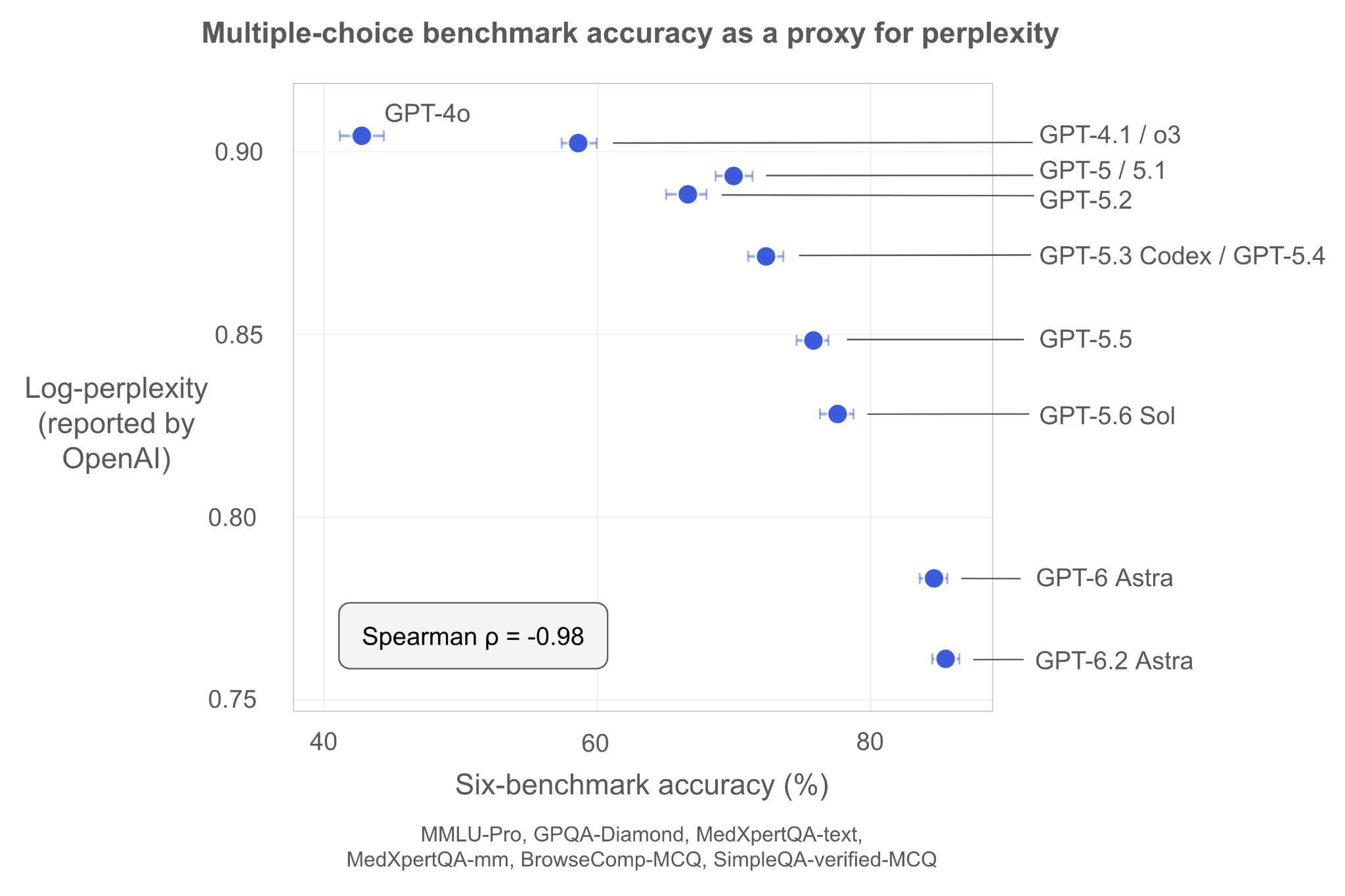
In the blog post “Perplexity and Intelligence”, OpenAI’s chief scientist Jakub Pachocki describes why perplexity is a strong single-number measurement of general intelligence. In the blog post, actual log-perplexity measurements of OpenAI models in the past five years are shown to demonstrate how perplexity improves with new models developed over time. And although Jakub advocates for perplexity as a shared metric for progress, the blog post does not offer a dataset for measuring perplexity that the community can use, as their results are measured on OpenAI’s internal codebase.
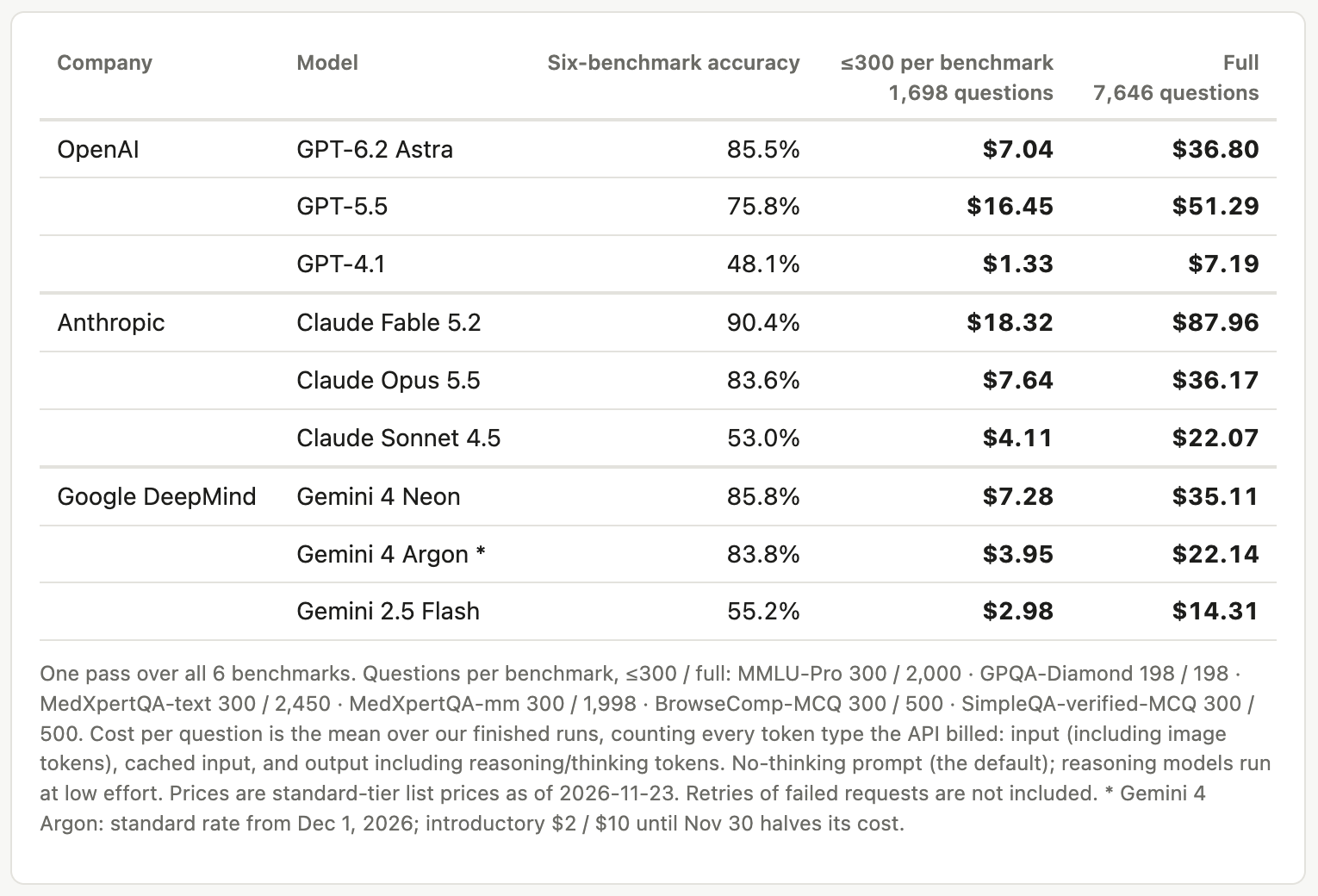
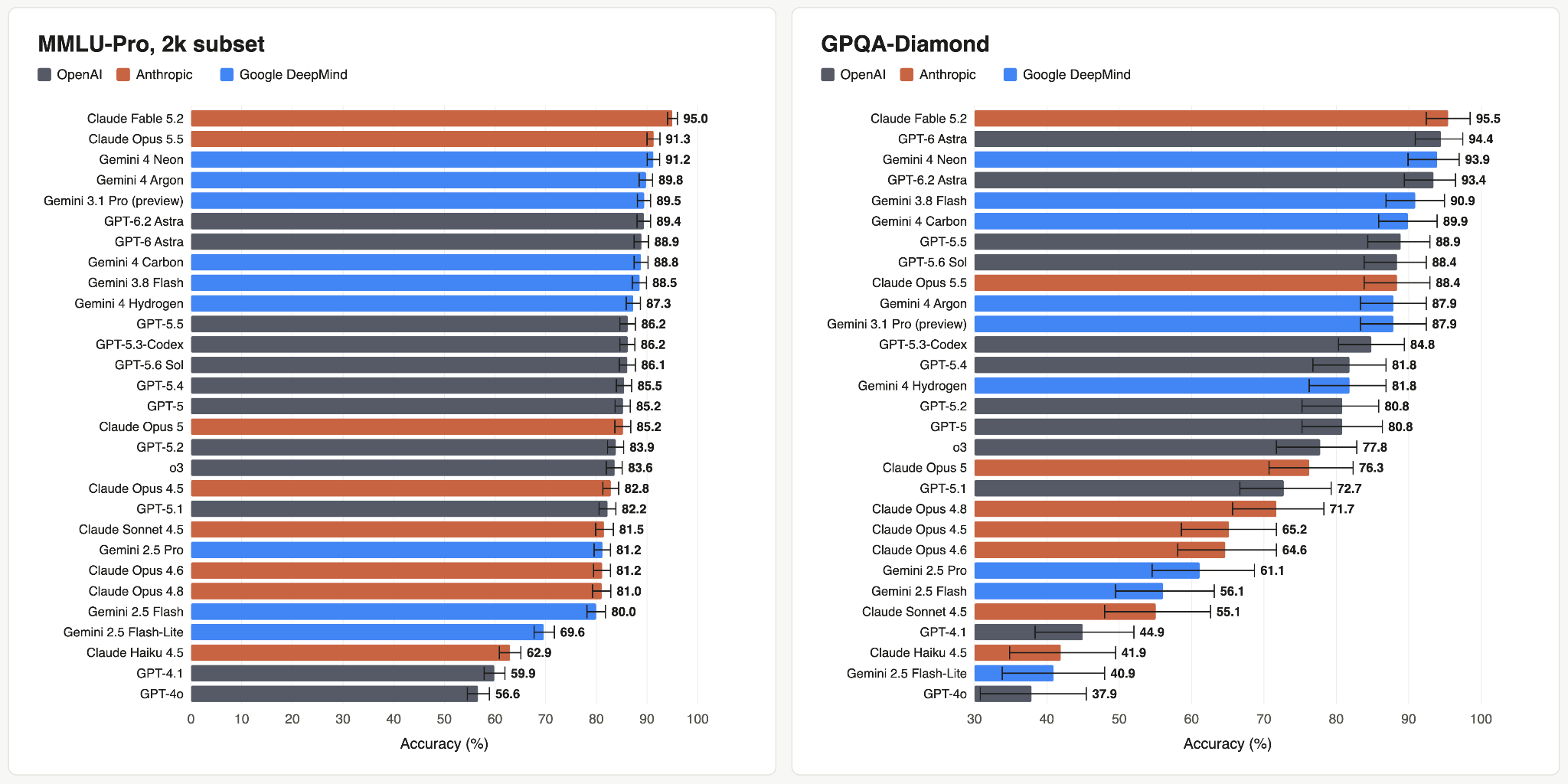
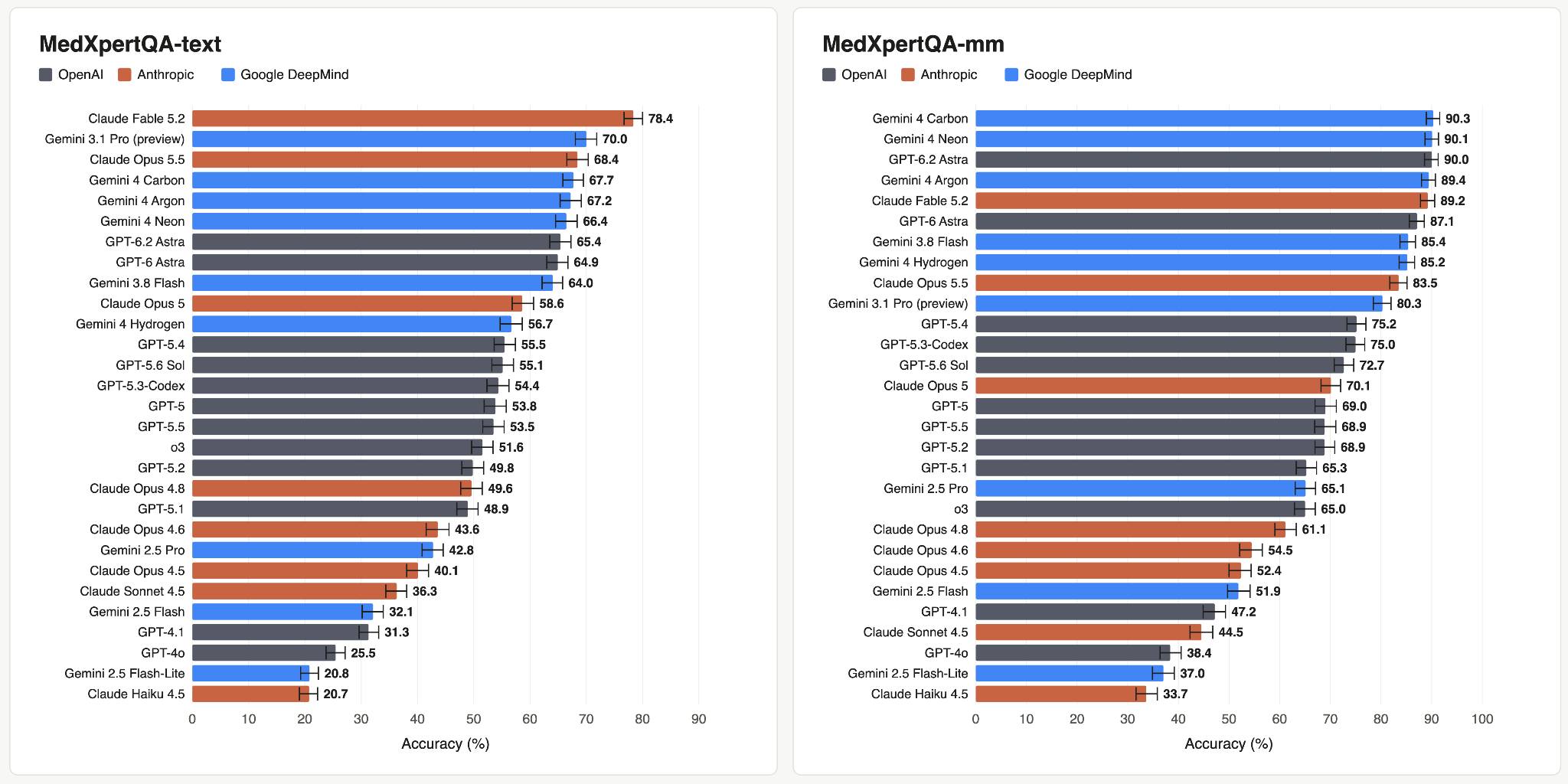
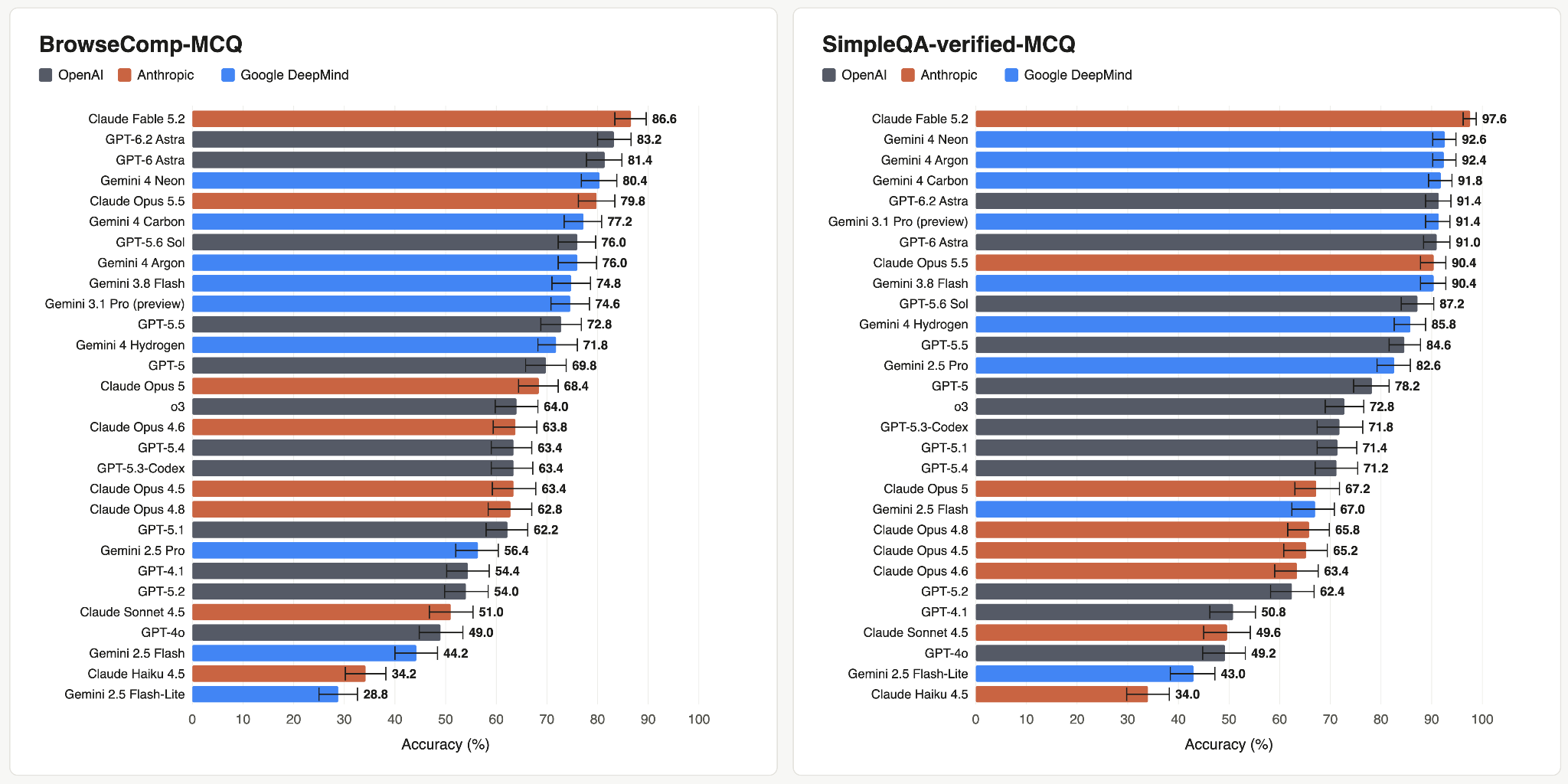
Here, we offer a simple, open-source proxy metric that strongly correlates with the perplexity measurements released by OpenAI. The metric is the unweighted average of six multiple-choice datasets: MMLU-Pro, GPQA-Diamond, MedXpertQA-text, MedXpertQA-mm, BrowseComp-MCQ, and SimpleQA-verified-MCQ. As shown in the plot opening this blog post, when running the nine OpenAI models still available in the OpenAI API using the lowest reasoning strength available (or no reasoning), this proxy metric has a strong Spearman correlation with reported perplexity measurements released by OpenAI. A favorable feature of this evaluation is that it is affordable to run; for example, running each of the six datasets with up to 300 examples using GPT-6.2 Astra costs only seven dollars.
In hindsight, it is not surprising that multiple-choice benchmark accuracy correlates with perplexity. Unlike most evaluations that we run for frontier models today that require models reasoning for a long time and producing long-form answers that are checked either by rubrics or programmatic test cases, all six of these evaluations are multiple choice. Multiple-choice questions do not reflect real-world use cases but are robust measures of raw intelligence because they do not depend on comprehensiveness and response style. Moreover, multiple choice questions in aggregate provide a smooth measure of improvement as models learn to do process of elimination and take better guesses among possible answers, as is done in next-word prediction. Crucially, perplexity measures performance of pre-trained models, before any post-training happens. Here, we tried to mimic this by running all experiments with the lowest reasoning strength available, to reduce the effect of post training and chain-of-thought reasoning.
When viewing perplexity as multi-task learning across a large number of tasks, it is also intuitive that the datasets proposed here correlate with general perplexity because both metrics exercise the same skills: world knowledge and reasoning. MMLU-Pro is a massively multitask dataset (as per the name) that includes subjects ranging from STEM, business, social science, law, humanities, health, and more. GPQA-diamond provides questions across chemistry, physics, and biology, which are all domains exercising both world knowledge and scientific reasoning. MedXpertQA is a set of challenging questions filtered from a database of medical exams and textbooks, with good topical breadth. Multiple choice versions of BrowseComp and SimpleQA measure cold, hard factual recall, which is a proxy for compression and hence intelligence.
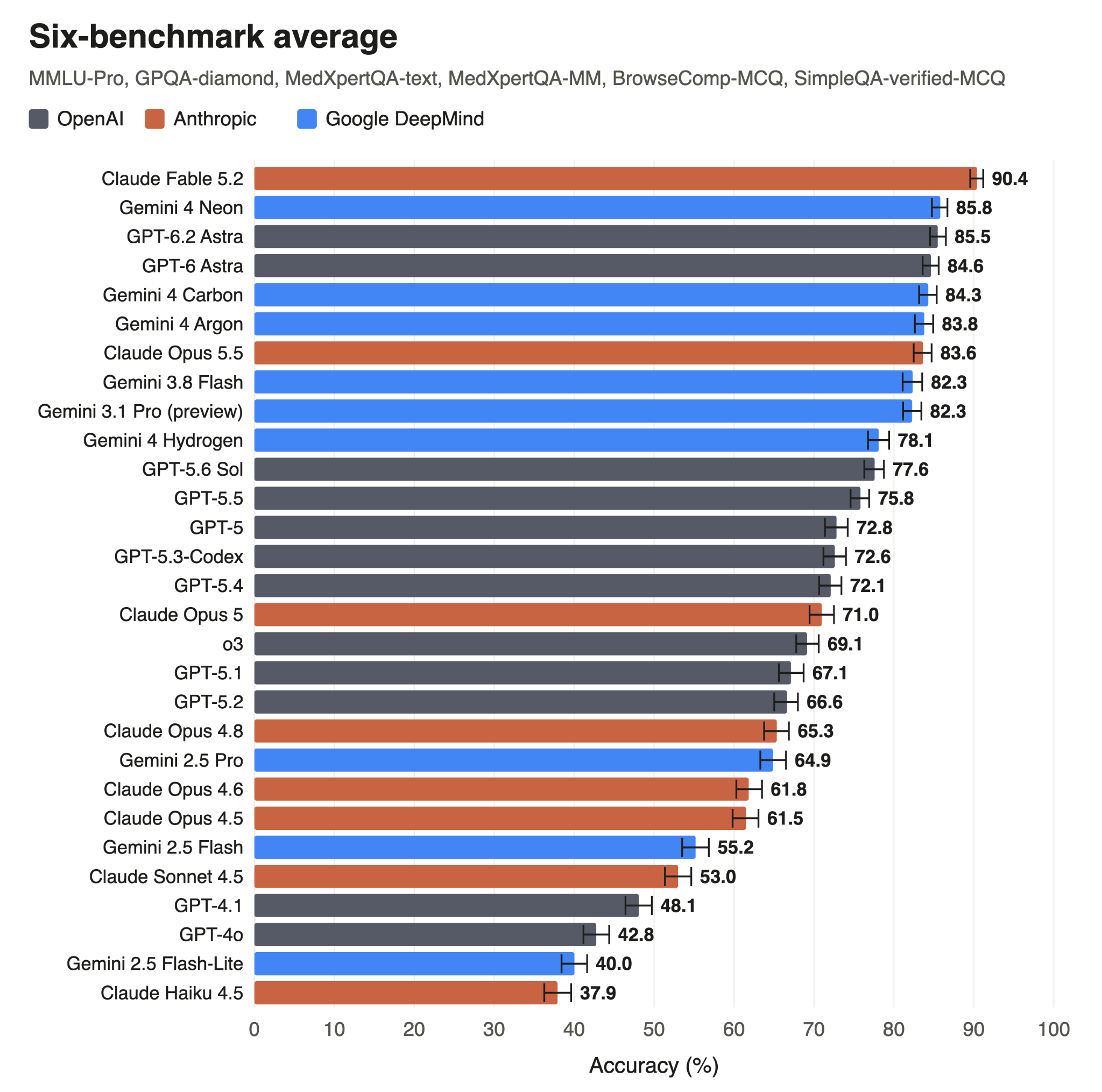
We can use these six-benchmarks to also evaluate models from Anthropic and Google DeepMind, though corresponding perplexity numbers for them are not available. We find that Claude Fable 5.2, Gemini 4 Neon, and GPT-6.2 Astra are the strongest-performing models, as would be expected, and that models generally increase in benchmark performance as their version number increases.
There are likely many multiple choice benchmarks that would provide good proxies for perplexity. The datasets we have proposed here have good empirical fit to the data generously made available by OpenAI, and they are popular open source benchmarks that are simple to understand and use. Like any benchmark, they are subject to Goodhart’s Law, and the proxy the field uses for perplexity will likely evolve over time.
Perplexity is a beautiful metric that has survived the test of time in our field. At its core it measures massively multitask learning in a general way and is not so enigmatic—here we argue that perplexity can be estimated by multiple choice datasets of sufficient diversity and difficulty. We hope this six-dataset proxy described provides a starting point for discussion on an open-source shared evaluation for general intelligence.
Appendix
For OpenAI models, evals were run using their API. When a pair of post-trained models had the same reported perplexity by OpenAI (e.g., GPT-4.1/o3), we ran both models and took their average score. Grading was done via exact match. We only ran MMLU-Pro on a 2k subset. BrowseComp-MCQ and SimpleQA-verified-MCQ were created by taking questions and converting them to multiple choice by having GPT-OSS generate 9 distractors.
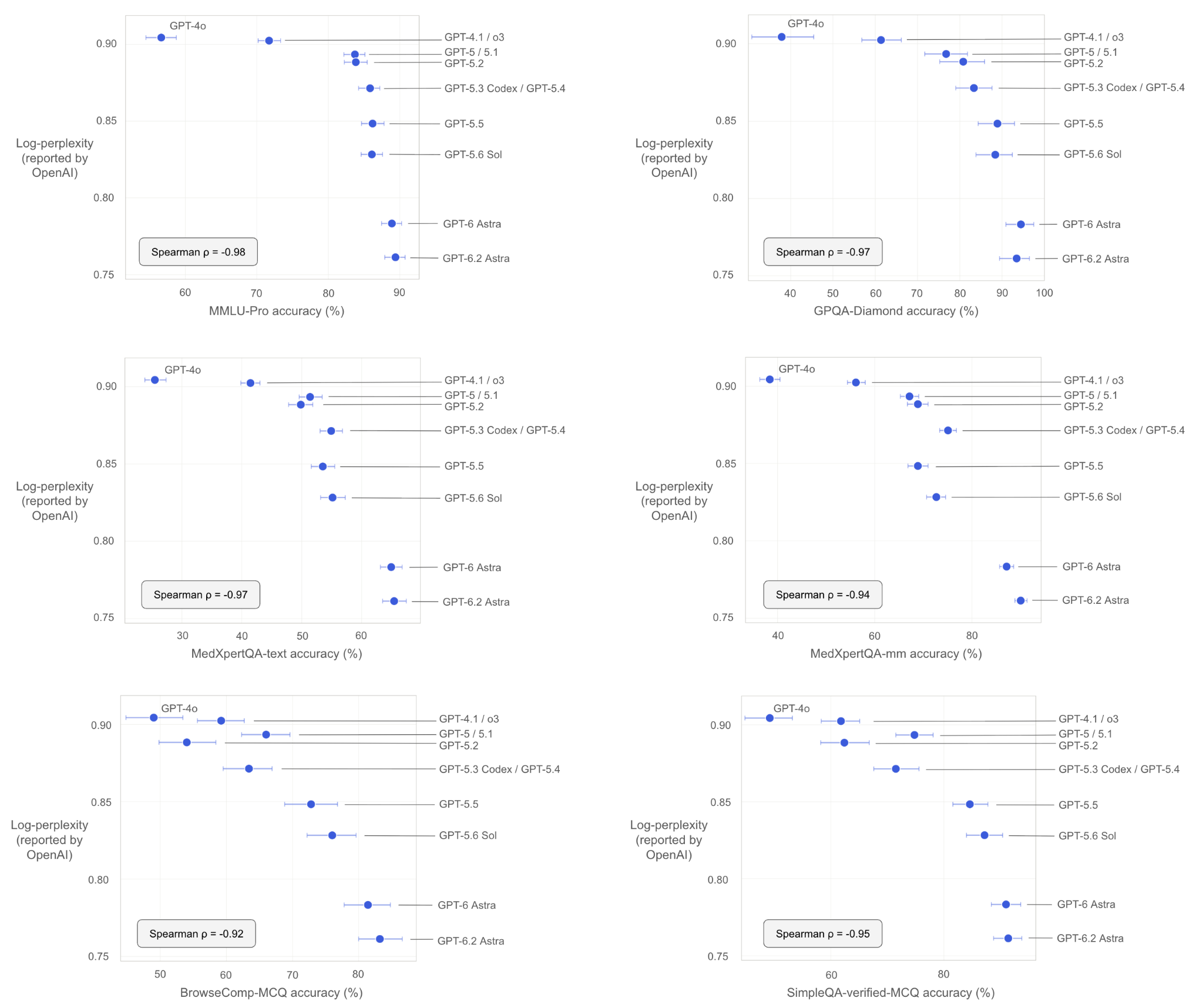
Results for the six individual multiple-choice benchmarks in our experiment.
Six benchmark performances for models we evaluated from OpenAI, Anthropic, and Google DeepMind.
Running these six benchmarks, or a subset of them, is cheap even for frontier models.