Introducing TaskNet: A New Taxonomy of Work

Introduction
AI is rapidly changing our relationship with work, and people are concerned about what those changes mean to them. What will work of the future look like and what skills will be needed? How do we train people for jobs that do not yet exist? Answering these questions requires detailed and up-to-date knowledge of what people actually do at work, yet no taxonomy fully captures the complexity and diversity of tasks and jobs in today’s workforce.
Today, researchers from Stanford, Mercor, and O*NET Resource Center, and the National Bureau of Economic Research released a working paper describing TaskNet, a new open-source catalogue of tasks across six different occupations in the US economy, updated to reflect the impact of AI on professional work. TaskNet builds off the structure of O*NET, the US Department of Labor's widely used map of occupational tasks. O*NET provides standardized descriptions of the tasks, skills, and knowledge associated with different occupations, helping both researchers and workers better understand occupations. TaskNet extends O*NET with a fast, scalable interviewer for identifying new tasks that will allow it to keep up with the rapid pace of change. TaskNet focuses on speaking directly to workers in order to better understand a profession, while also eliciting worker judgment on task features relevant to automation like how hard is it to judge the quality of their output or how easy it is to define success a priori.
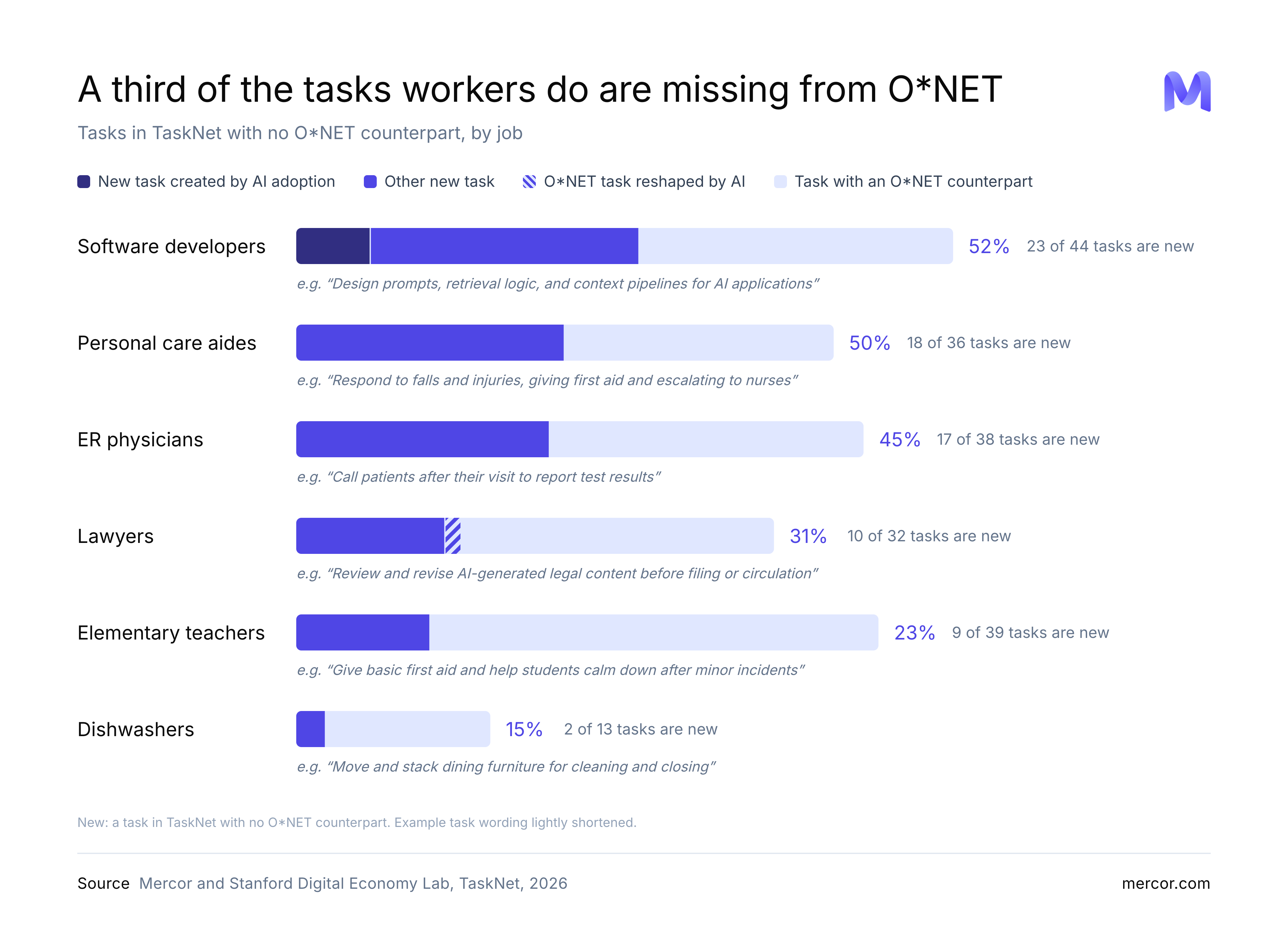
The result is a more comprehensive and accurate catalogue of modern work. In our initial sample of 6 occupations, TaskNet identifies 79 additional tasks that were validated by O*NET analysts but that had no O*NET counterpart. This includes 5 tasks that were newly created or reshaped as a direct result of AI adoption.
Using an AI Interviewer at Scale
TaskNet v1 uses a scalable method of capturing expert insight: AI interviews. Traditional occupational taxonomies like O*NET relies primarily on surveys to elicit task information. While surveys allow for a high degree of standardisation, it can be difficult to identify emerging tasks in a static questionnaire. Interviews, on the other hand, are well suited for eliciting and understanding new tasks. They can be more exploratory in nature and adaptive to make sure that new tasks or information are fully articulated. However, interviews conducted by humans are expensive and hard to scale.
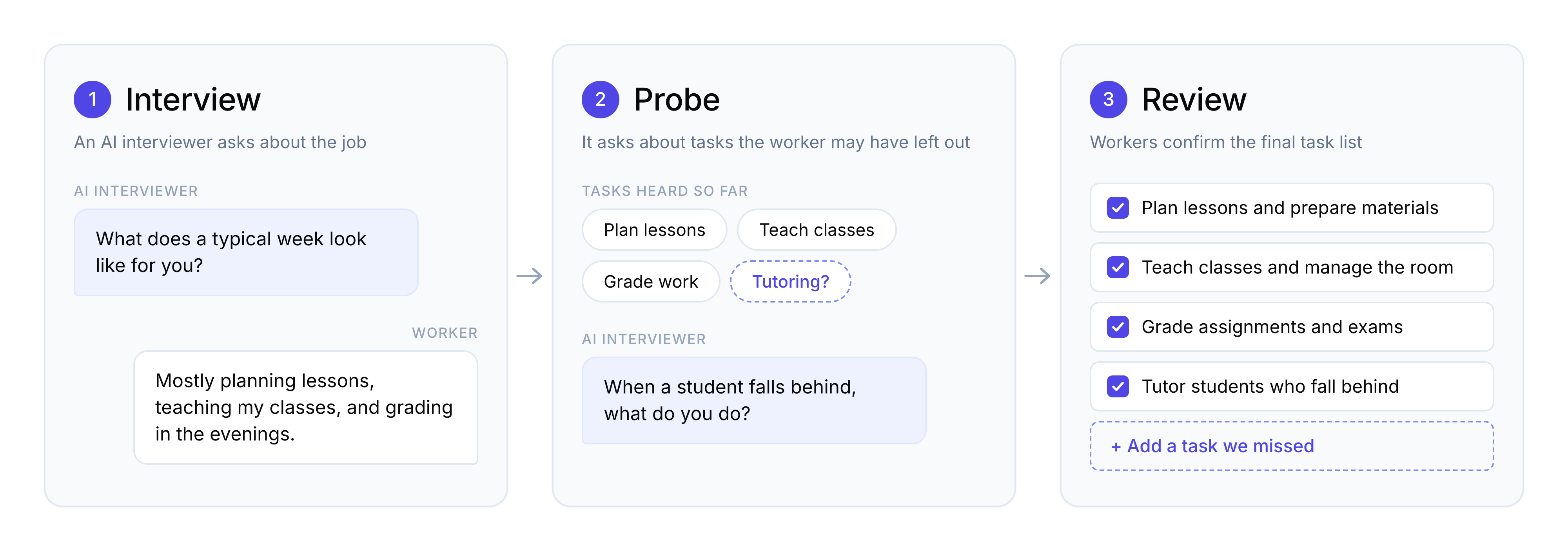
TaskNet solves these problems by using a language model as an interviewer. Mercor has long been a pioneer in deploying adaptive AI interviews at scale, having completed over 3 million interviews and counting since 2023. The Stanford research team, on the other hand, has helped pioneer adaptive interviewing techniques with projects like SparkMe. TaskNet v1, an academic research collaboration, brings researchers together to create a mixed-initiative system that interviews workers about their tasks, asks follow-up questions to clarify ambiguous descriptions, and works with them to confirm their task bundles.
To validate the resulting task lists, O*NET analysts reviewed all 229 candidate statements and found that they all fit the O*NET center’s standards for a valid task. Analysts did flag that some tasks departed from O*NET ’s style guidelines or described work primarily performed by another occupation, leading to a rewrite of 21% of tasks.
We also took a holdout set of 1,184 task reports from 57 workers whose interviews were not used to build the TaskNet dataset. Our lists covered 89.3% of reported tasks on average across the six occupations, compared with 78.6% for O*NET itself. For a full technical explanation of TaskNet and its validation procedure, see the preprint.
Results
TaskNet increased task coverage for O*NET occupations and identified new occupational tasks not covered by O*NET. When tested on a held-out set of validators, our method produced a task list that workers rated as more representative than O*NET. The 79 new work tasks represent billions of hours of work a year, or an estimated $140B a year in time-adjusted wages.
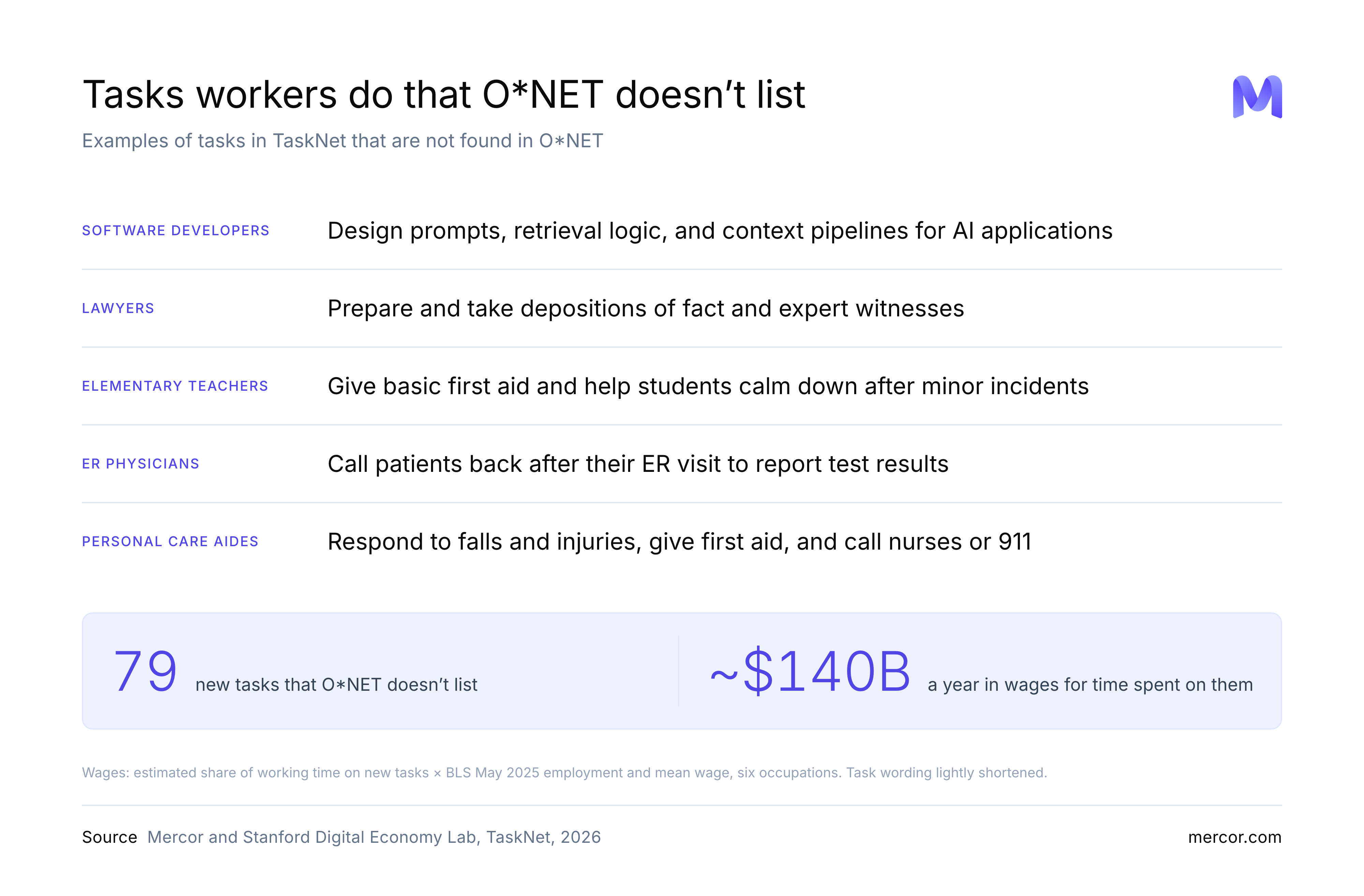
Many of these tasks missing from O*NET fall into the bucket of work that is done, but not often accounted for - elementary school teachers administering basic first aid, for example, or ER physicians calling patients with test results.
“If you understand a doorman simply as a way to open the door, of course you can yield cost-savings by replacing him with an automated system. But if you understand a doorman as a way to elevate the status of the hotel & create a better guest experience (hail taxis, greet guests, carry bags...), then you realize the full role of the doorman cannot be replaced with an automated system.”
— Rory Sutherland
Behavioral economist Rory Sutherland calls this the doorman fallacy - when we assume a job is made up only of its most visible tasks. By interviewing workers directly and at scale, TaskNet helps bring these essential tasks into an official taxonomy.
We also discovered five new tasks that did not exist before the proliferation of modern LLMs. Most of these examples come from software engineering like designing prompts and context pipelines, or writing evals for different AI systems. However, we also observed new tasks in a non-technical field; lawyers reported that they now spend time reviewing and revising AI-generated legal content for accuracy, compliance, and supporting authority before filing or circulation. Expanding the TaskNet interviewer to more occupations and repeating interviews over time will allow us to discover even more emerging tasks, as well as observe which tasks have a shrinking timeshare.
Exposure Scores
We found that utilizing this updated taxonomy increased AI exposure scores for software developers, lawyers, and elementary school teachers. Much of this increase was due to the addition of the aforementioned tasks that don't immediately come to mind for these professions but still constitute millions of hours of work each year. For lawyers, software developers, teachers and physicians these tasks were mainly clerical work around documenting, communicating, and keeping records.
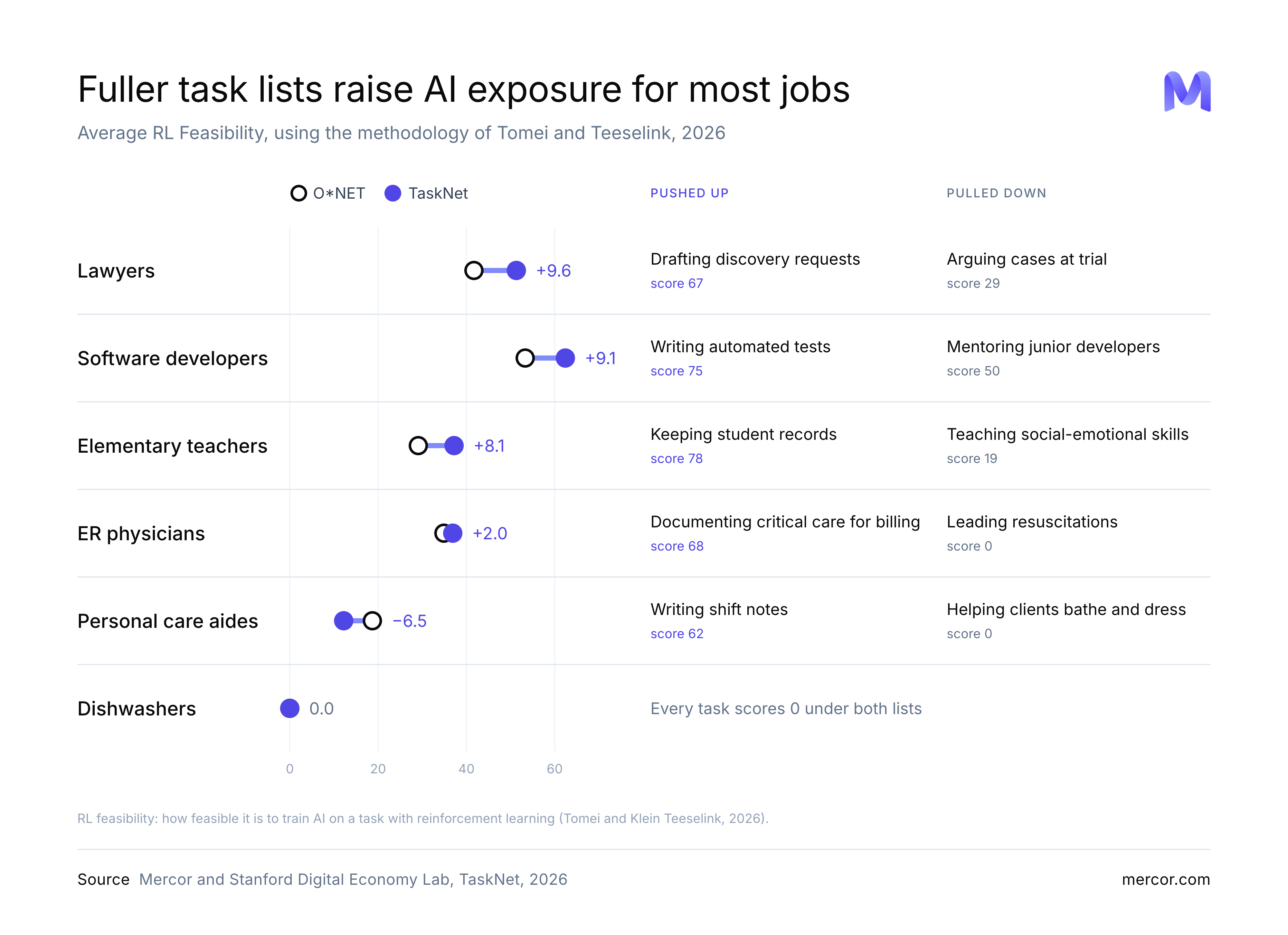
For personal care aides, we saw a decrease in exposure, mostly due to the addition and refinement of more tasks that were physical or relationship based like helping clients dress, or caring for a client’s pet.
We also ranked tasks by relative expertise, how much better the best person is at this task than the average person. For software developers, the most AI exposed tasks were the ones with the lowest returns to additional expertise. Among the tasks that are easiest for AI to learn, only 34% of developers say top performers clearly outperform the average developer. For the more difficult to learn tasks, 62% say top performers clearly outperform the average developer. Lawyers show a similar pattern: the tasks where expertise matters most, like negotiating settlements, arguing at trial, and advising clients, score lowest on RL feasibility.
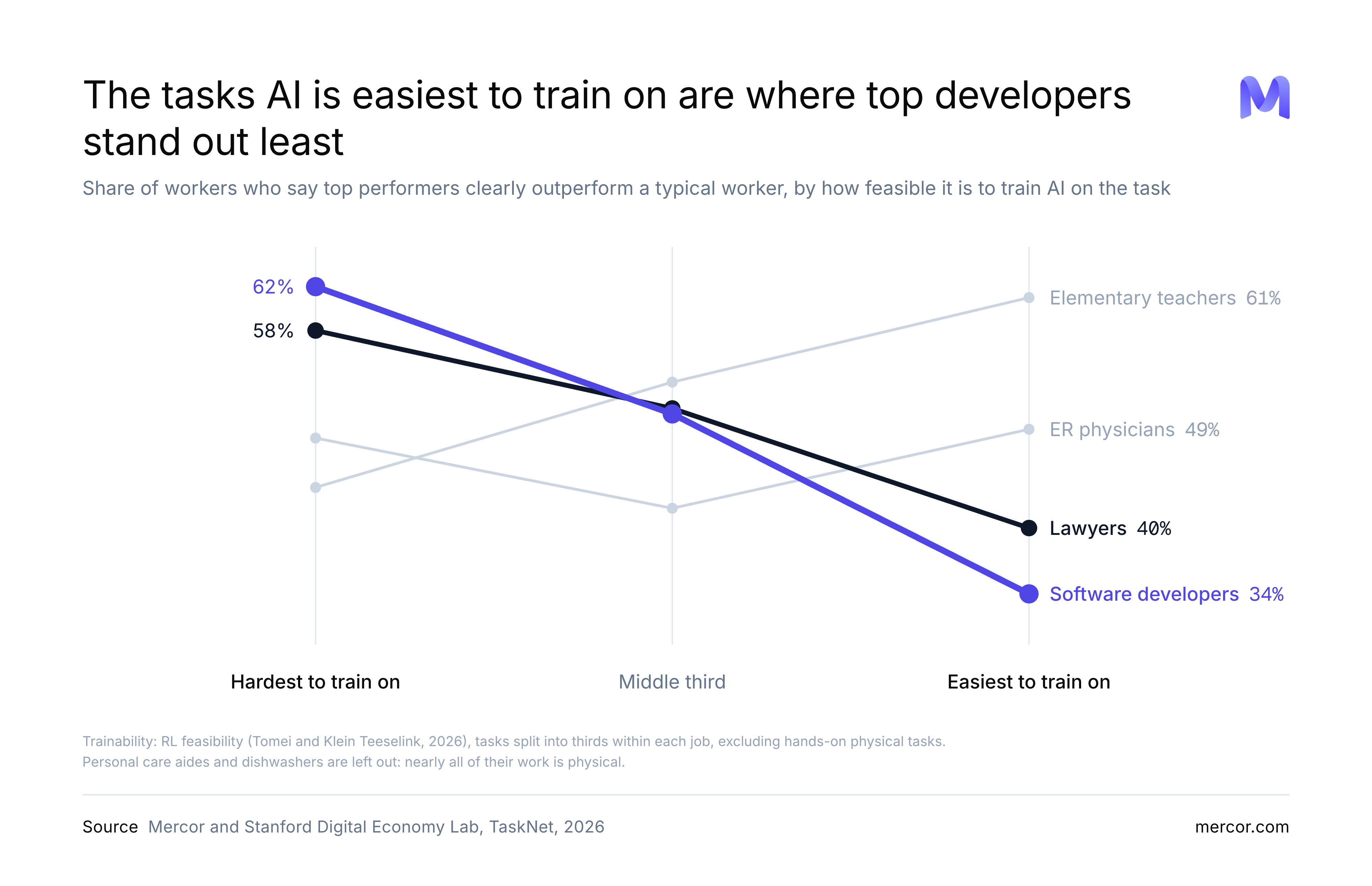
These results show how much our estimates of AI exposure and our understanding of what tasks are durable depend on the work that is included in our taxonomies. Using TaskNet we were able to identify both longstanding responsibilities missing from O*NET and newly emerging tasks associated with AI adoption. We hope to extend TaskNet to more occupations and repeat the interviews over time. Broadly, LLMs offer a way to collect detailed accounts of work and opinions at an unprecedented scale. We believe that a combination of this new technology, along with careful thought from industry, academia, and policymakers, will help us build the foundations to better understand work today, how it's changing, and what it will look like in the future.
Thank you to Andreas Haupt, Erik Brynjolfsson, Diyi Yang, Jenn Wang, and Phil Lewis for collaborating on this work.