Training frontier knowledge work agents: A 397B RL training guide with SkyRL


A step-by-step account of how we post-trained Qwen3.5-397B-A17B: we focus on the often overlooked infrastructure and derisking work preceding the hero run, show even stronger improvements on a larger model, and release the full training script.
This is the third post in our series on post-training open models with Mercor’s expert data. In January, we showed that fewer than 1,000 expert-labeled tasks could nearly double an open-weight model’s score on APEX-Agents. In February, we scaled the dataset to roughly 2,000 cases. The resulting model, Applied Compute: Small, post-trained from GLM-4.7 355B, took the top spot in corporate law and fourth place overall. Both runs used a proprietary RL stack. This post opens the recipe: we reproduce those gains on public SkyRL, extend them to 397B parameters, and release the full training script, the model weights, and the eval traces.
The open-source community has made real progress on how to train competitive coding agents [1,2] at 27B to 32B parameters. Much less research is shared publicly about knowledge work agents, because realistic environments are costly to build and long-horizon rollouts are costly to train on.
We address this gap by post-training Qwen3.6-35B-A3B with reinforcement learning (RL) to surpass Opus 4.5 on APEX-Agents [3], a benchmark of 480 realistic knowledge-work tasks. We then extended the best recipe to Qwen3.5-397B-A17B, which improved Pass@1 by 70% relative, from 16.11% to 27.29%. The script is designed to run on proprietary data, but we document the full task format so you can point it at your own.
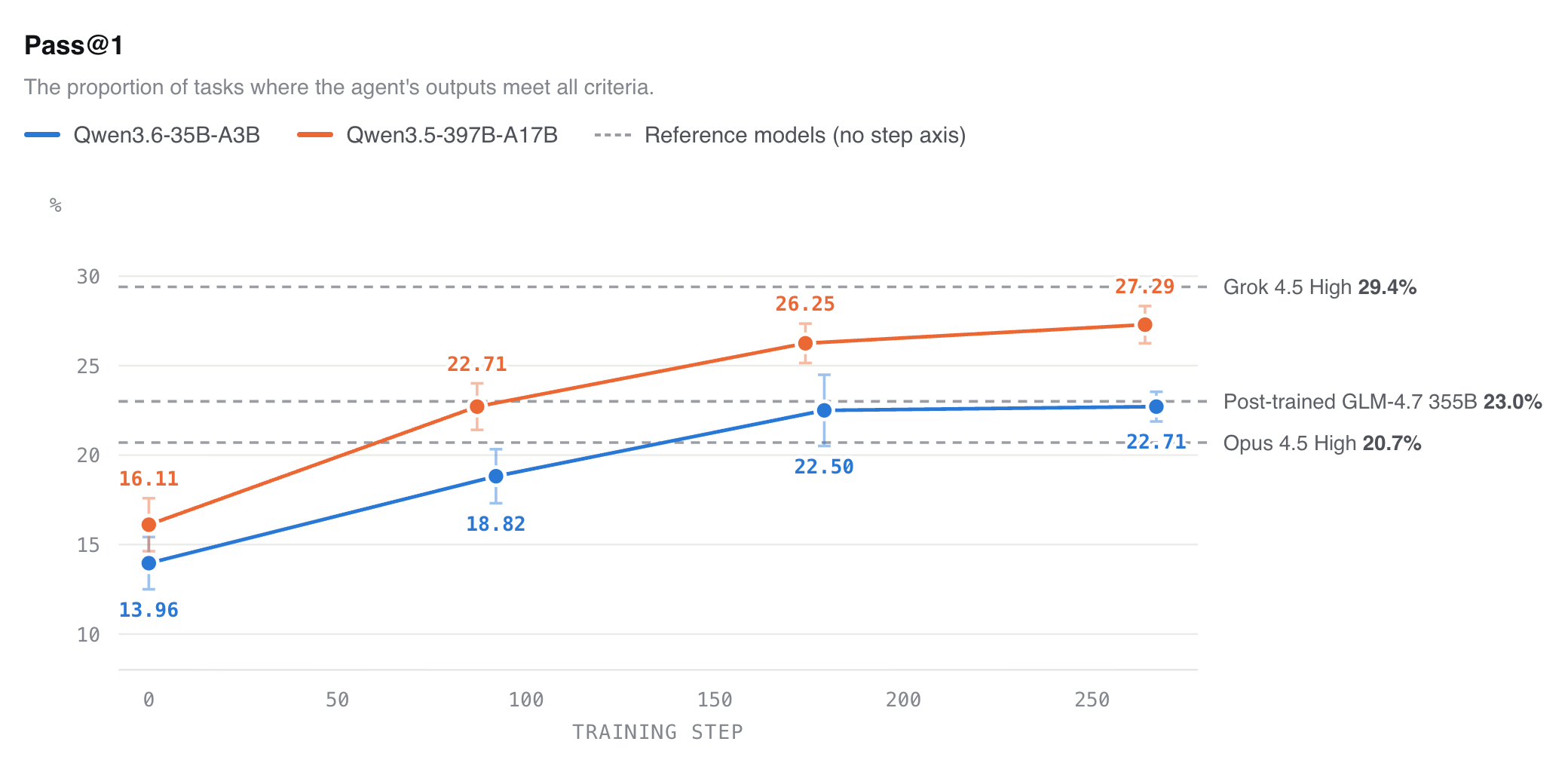
Figure 1: Pass@1 on the held-out APEX-Agents benchmark, before and after post-training on 1,928 expert-created APEX-Agents off-the-shelf tasks.
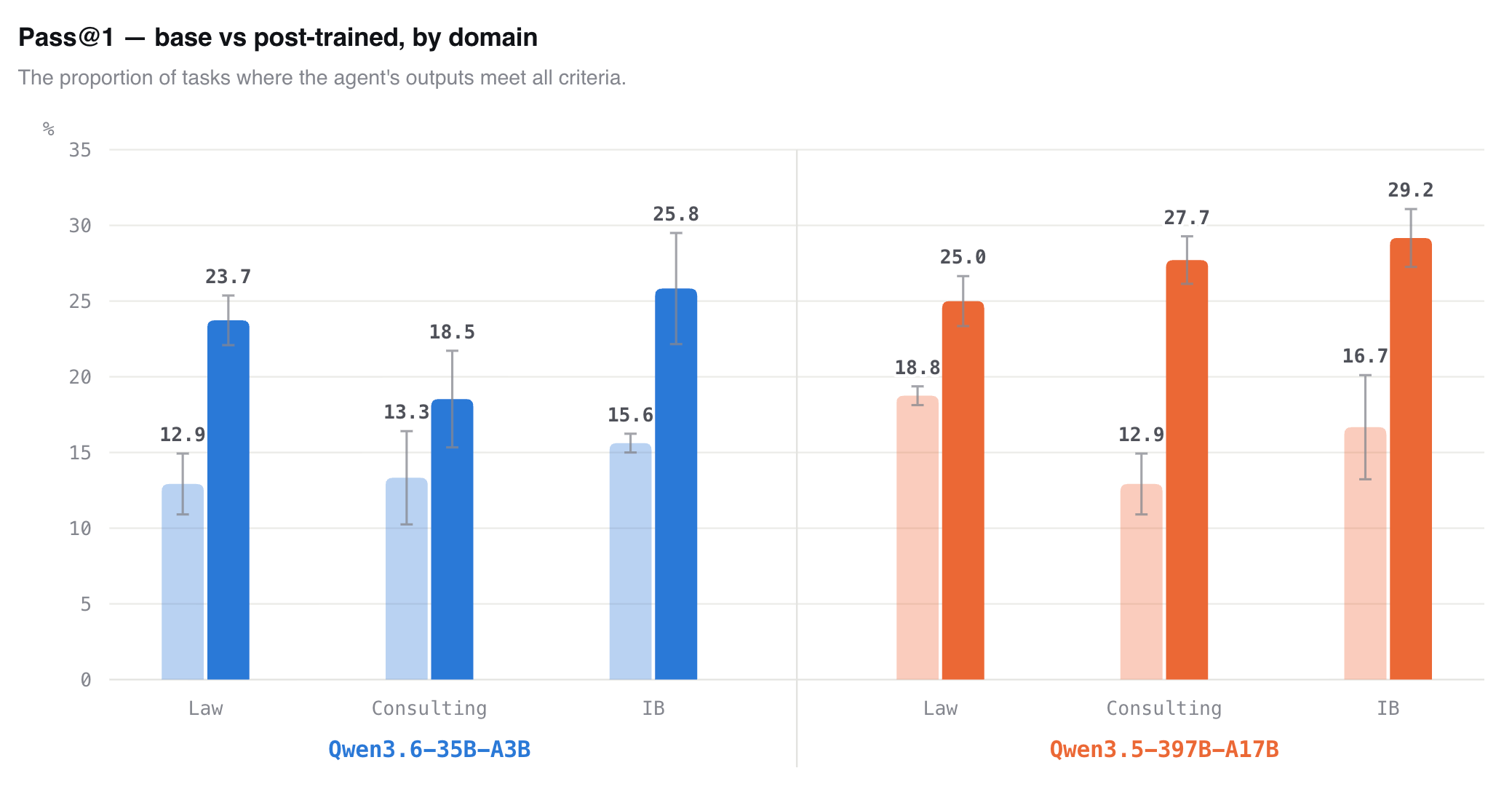
Figure 2: Gains by domain. Darker bars are the post-trained -Mercor models. The 35B gains most in corporate law; the 397B gains most in management consulting.
We take the final checkpoint of each run and refer to them as Qwen3.5-397B-A17B-Mercor and Qwen3.6-35B-A3B-Mercor.
In this blogpost, we give a step-by-step guide to frontier RL training for complex knowledge work, with the best practices we found and the lessons we learned.
Full training source code, model weights, and eval traces can be found at:
- github.com/Mercor-Intelligence/ApexAgents-SkyRL-Recipe
- huggingface.co/collections/mercor/apexagents-skyrl-recipe
This blogpost is organized as the following:
- Background: APEX-Agents and our training setup
- Step 1: Environment, harness, and token accounting
- Step 2: RL systems tuning
- Step 3: The overfitting run
- Step 4: Algorithm ablations on the 35B
- Step 5: The 397B hero run
- Step 6: Evaluation and generalization
- Lessons and forward-looking
Steps 1 to 3 are de-risking. We do not spend significant compute until Step 4.
Background: APEX-Agents and our training setup
APEX-Agents is Mercor’s frontier benchmark for long-horizon cross-application tasks in professional services. Unlike prompt-only tasks, each task lives in a world: a simulated company holding dozens of PDFs, spreadsheets, and slideshows, plus chat and email servers. Many tasks share one world. The agent works through MCP tools or code execution. The 480 benchmark tasks and all their files are public on Hugging Face, and you can read a sample investment banking task on the leaderboard.
We focus on RL without SFT warmup because RL is the hardest part of post-training to get right. We use SkyRL, built at Berkeley Sky Computing Lab in collaboration with Anyscale, for three reasons: it integrates arbitrary agent harnesses easily, it supports fully-async training, and its Tinker-compatible training loop lets us swap compute backends.
We anchor our study using APEX-Agents off-the-shelf (OTS) datasets: 1,928 expert-created tasks in management consulting, investment banking, and corporate law. They have the same shape as the public benchmark, but none of their worlds or prompts appear in it, so there is no contamination.
Step 1: Environment, harness, and token accounting
Get the environment and harness right before any RL. That means three things: robust environment infrastructure (failed trajectories waste GPU hours and bias the reward), a correct harness (quirks teach the model to route around your harness, burning exploration budget that should go to the task), and exact token accounting.
1.0 What runs where (both compute and code)
We use Harbor for both the data format and rollout lifecycle management. Harbor comes from the team behind Terminal-Bench: it evaluates and optimizes agents in container environments, runs trials in parallel across sandbox providers like Modal and Daytona, and generates rollouts for RL. On top of it we implement our own BaseAgent (code here), equivalent to Mercor’s archipelago loop agent.
A Mercor OTS data delivery ships each world as an image.tar, which we push to ECR; at trial time Modal pulls that image to boot the sandbox. The image holds the world’s filesystem and runs the MCP servers that operate on it (Docs, PDF, Email, Chat). The agent loop connects to the sandbox’s MCP servers and exposes their tools to the LLM. In our setup the agent loop runs on the GPU nodes; it could equally run inside the environment sandbox, in a separate container, or on other CPU nodes in the Ray cluster.
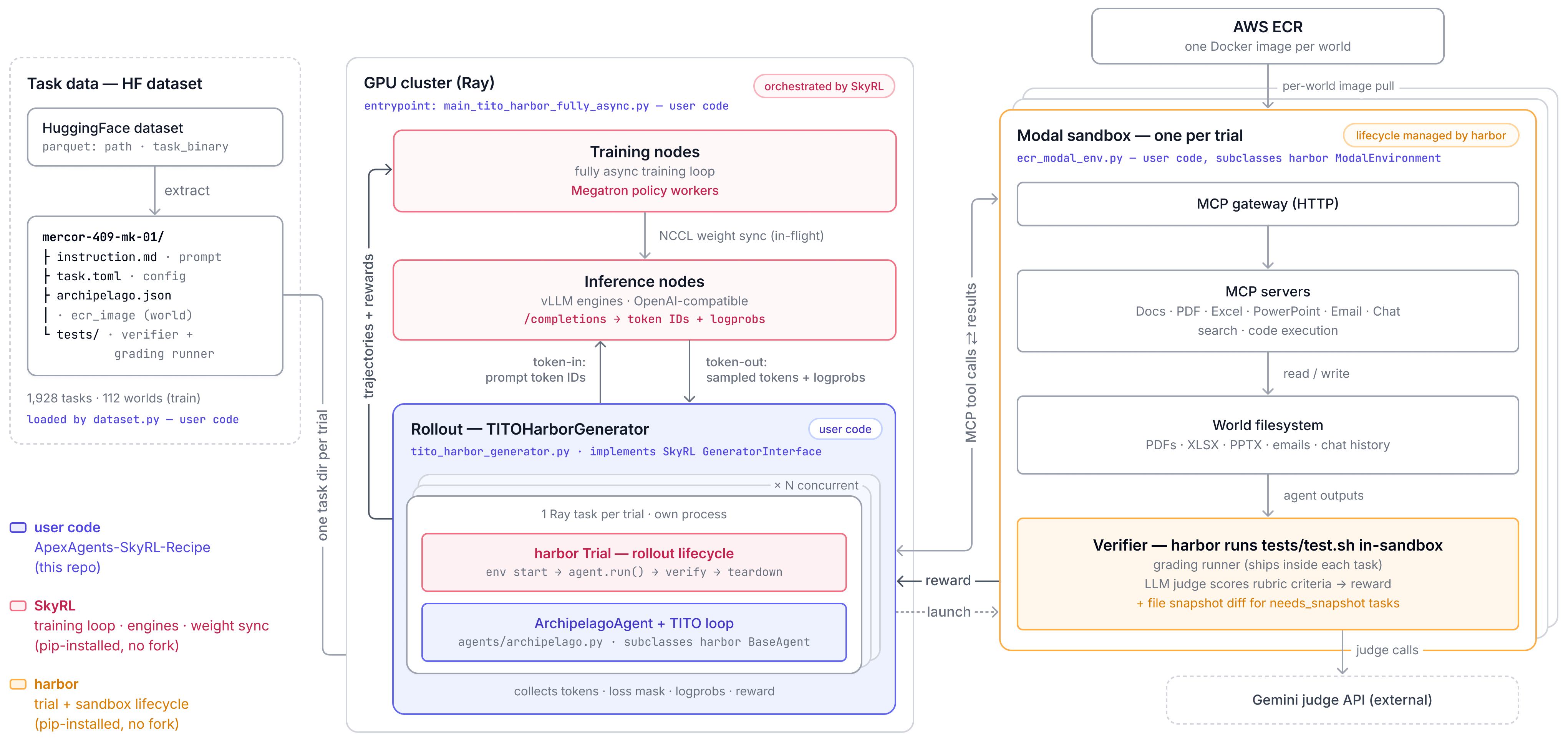
Figure 3: What runs where for one RL trial. Left: training data is a HuggingFace dataset of prebuilt Harbor task directories (prompt, config, verifier), and each trial consumes one task directory. Middle: on the Ray GPU cluster, SkyRL provides the fully-async training loop, the vLLM engines, and in-flight NCCL weight sync; each trial runs as its own Ray task, where Harbor’s Trial drives the rollout lifecycle (env start → agent.run() → verify → teardown) around our ArchipelagoAgent, which exchanges raw token IDs with the engines. Right: every trial gets a Modal sandbox booted from its world’s ECR image, exposing MCP servers over the world’s filesystem; after the agent finishes, Harbor runs the verifier in-sandbox, and the reward joins the trajectory flowing back to the trainer.
The recipe repo is deliberately small: SkyRL and Harbor are pip-installed dependencies, no forks, and the code you write is a handful of files.
ApexAgents-SkyRL-Recipe/
├── apex_agents_skyrl_recipe/
│   ├── entrypoints/
│   │   └── main_tito_harbor_fully_async.py  # entrypoint: wires our config into
│   │                                        #   SkyRL's fully-async trainer
│   ├── tito_harbor_generator.py   # the one piece of SkyRL code you write:
│   │                              #   implements GeneratorInterface, runs each
│   │                              #   trial as a Ray task via harbor's Trial
│   ├── agents/
│   │   └── archipelago.py         # the MCP tool-calling agent, a harbor
│   │                              #   BaseAgent subclass; the rest of agents/
│   │                              #   are its helpers (e.g. TITO bookkeeping)
│   └── harbor_trial_config/
│       └── archipelago_tito.yaml  # agent + trial config: timeouts, retries,
│                                  #   sandbox settings
│
└── scripts/                       # launch scripts holding every SkyRL training
                                   #   knob we tuned in Steps 2 and 4
1.1 Environment infrastructure robustness
Once you know what runs where, the job is to drive environment failures down and keep the GPUs busy. This is largely a whack-a-mole process, but to give you a flavor:
- Put a timeout on everything. File downloads, MCP interactions, container teardown. Anything without a timeout will eventually hang a rollout for its entire end-to-end budget.
- Bypass LLM-judge rate limits. An eval pass generates modest judge traffic, but RL at 800+ concurrent rollouts hits rate limits hard. Round-robin across judge API keys if needed and retry with backoff, as in
agents/llm.py. - Isolate MCP clients per process. Sharing one Python process across hundreds of agent loops caused constant MCP disconnects, making the environment an unnecessary bottleneck. We run each agent loop as its own Ray task.
- Classify every remaining error as fail-the-trial vs. retry. One benefit of building on Harbor is that much of this fault tolerance already exists (search
@retryinharbor-framework/harbor); the patches we added on top are inagents/archipelago.py, and the failure signatures we match on are inmetrics_helper.py.
Suggestion. Run an evaluation pass over your full training set at the concurrency you expect during RL, 300–600 rollouts for us, and drive the non-model error rate as close to zero as possible before training. Step 2 covers how we picked that ceiling. Do not rely on “masking errors during RL” too much.
1.2 Optimize the harness
With the infrastructure stable, look at the harness itself. Run an evaluation pass with the untrained model, then read the traces: how many failures reflect genuine model limitations, and how many come from harness quirks or outright bugs? Minimize the latter before RL, so training teaches real capability instead of workarounds.
These issues only surface by reading traces. That is slow manual work, but coding agents automate it well: ask them to systematically analyze traces and use metrics like per-tool failure rates to find patterns. Issues we found this way include:
- Some Python packages were initially missing from the sandbox, so agents burned many turns discovering what was actually installed, or fell back to sometimes-less-ergonomic MCP servers.
- The PowerPoint MCP tool returned
Nonefor every call even when it succeeded. We patched the MCP tool implementation inslides_output_validation_fix.py. - The PDF-reader MCP tool flattens 2-D layout into 1-D text, garbling multi-column tables. We nudged the model to use the Python package
pdfplumberinstead.
These additions to the harness also helped:
- Nudge the model to wrap up when it is close to exhausting its context budget.
- When tool-call parsing fails, prompt the model to retry instead of failing the trajectory outright.
- Truncate tool results to a fixed token/char budget so a single call cannot blow the context.
Together these fixes raised the base Qwen3.6-35B-A3B from 22.74% to 28.69% mean reward, with zero training. Those fixes bought roughly what one epoch of training would have bought on the unfixed harness.
All harness tweaks are in the released codebase.
1.3 Token-in-token-out (TITO)
Finally, make the harness RL-friendly by ensuring TITO, the exact token accounting named above.
What is TITO? Several posts have covered why this matters for RL [4, 5]. In short: when converting the inference engine’s output into the trainer’s input, we must not re-tokenize the engine’s text output, which causes two kinds of misalignment: (1) between what the LLM actually generated and what the trainer thinks it generated; (2) in multi-turn settings, between the output token IDs of turn N and the input token IDs of later turns. Say the vocabulary has four tokens: 0: <, 1: search, 2: <search, 3: >.
If the LLM generates 0, 1, 3 and we hand the trainer the string <search> without bookkeeping the tokens, it may re-tokenize to 2, 3, a silent misalignment that makes training off-policy.
How to achieve TITO. There are roughly three options:
- Rewrite the harness to use
/completionsinstead of the string-in-string-out/chat/completions. Most control, most engineering effort. - Ask
/chat/completionsto return input and output token IDs (e.g. vLLM'sreturn_token_ids). Low effort, but it does not address misalignment (2), so each trajectory splinters into multiple training sequences, hurting systems performance. - Have the RL framework provide a proxy that translates
/chat/completionsinto/completionsand tracks tokens internally. Most convenient, at the cost of some implicitness (e.g. around harness-side retries). This is coming soon to SkyRL (issue).
We adopt the first approach; implementation details in agents/tito.py.
Step 2: RL systems tuning
With the environment and harness settled, we turn to the RL stack itself. For long-horizon agentic RL the default is fully-async training with in-flight weight updates, to minimize the effect of stragglers [6, 7]. We use vLLM as the inference engine and Megatron as the training backend, and we tune in this order.
1. Optimize Megatron knobs. Spend one overnight Claude Code session optimizing Megatron for speed, using a dummy script to sweep:
- Parallelism (TP/EP/PP/CP)
- CPU-offloading granularity
- Micro-batch size (
max_tokens_per_microbatch). We use dynamic micro-batching, which is crucial for trainer throughput.
2. Split the cluster between rollout and training. The rule of thumb we took: fix the number of training GPUs given your compute, then allocate as many rollout GPUs as you can such that the trainer does not wait. In SkyRL this shows up in the timing/wait_for_generation_buffer panel, where 0 means the trainer never waits on generation and hence is always busy. Our inference-to-train node ratios were 12:4 for the 35B runs and 12:8 for the 397B run.
3. Set rollout concurrency. Rollout concurrency (generator.rate_limit.max_concurrency in the recipe repo) has two ceilings; set it to the lower of the two.
- The systems ceiling, usually the binding one for long-horizon tasks, is KV cache: total KV-cache capacity in tokens divided by the average trajectory length. Raise it with CPU KV-cache offloading or higher parallelism degrees (TP / PP / EP).
- The algorithmic ceiling is your staleness tolerance in fully-async training,
(max_staleness_steps + 1) × mini_batch_size × n_samples_per_prompttrajectories, for us(3 + 1) × 16 × 16 = 1024. Past that, extra trajectories are too stale for the trainer to accept.
The systems ceiling bound in both of our runs: we set concurrency to 550 for the 35B and 300 for the 397B, well under 1024.
4. Check train-inference mismatch. With the configuration set, run a few training steps and compare logprobs between trainer and inference engine. This check is how we caught a correctness issue in the combination of vLLM CPU offloading, GDN models, and in-flight weight updates. Our diff stayed small without rollout router replay.
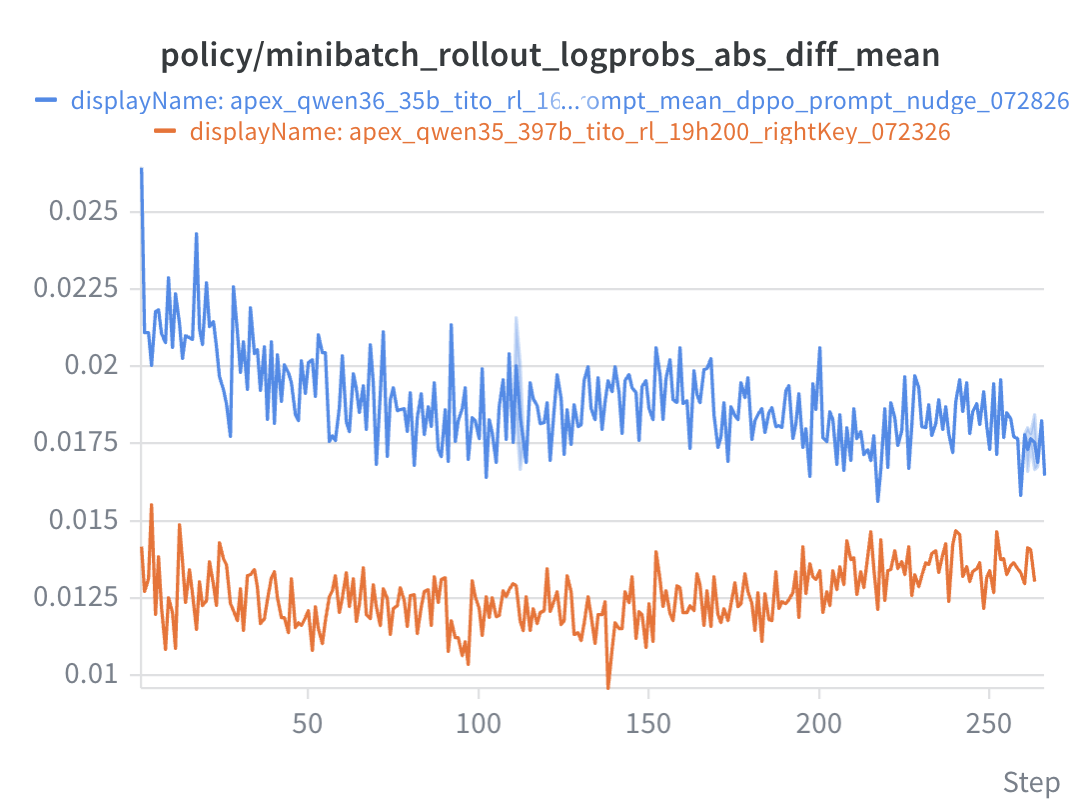
Figure 4: Mean logprob difference between trainer and inference engine. Below 0.03 is usually a healthy sign.
All relevant knobs are in the training scripts in the recipe repo.
Step 3: The overfitting run
With the environment and RL systems ready, we can finally launch runs, but not the hero run yet. First, de-risk with an overfitting run to confirm the tasks are learnable: if you cannot overfit a handful of tasks, an end-to-end run has no chance. We use a 32-task subset (each with non-zero reward variance during offline eval) with batch size 32 and 8 samples per prompt, trained synchronously, so every step is one epoch.
If overfitting fails, walk back through the earlier steps to find what went wrong (usually Step 1). For example, we found that tasks graded by diffing files before and after the rollout were much harder to overfit than tasks graded on the final response alone. That pointed us at the grading logic: switching to a third-party file-diffing tool made file extraction much higher fidelity, and the tasks became learnable.
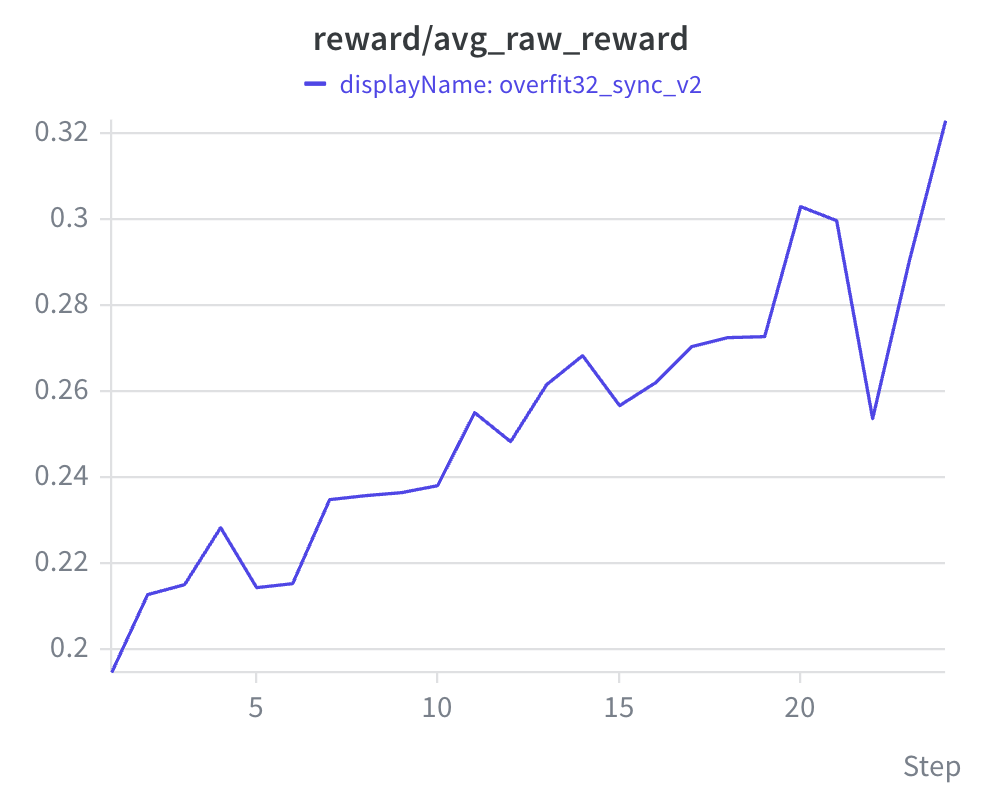
Figure 5: Overfitting run on 32 tasks. You should see learning signal within a small number of steps.
Step 4: Algorithm ablations on the 35B
With the de-risking done, we can finally spend compute on science. In RL, reward shape, exploration, and systems throughput all move at once, so scaling studies are less clean than in SFT. We therefore ablated a few knobs we had concrete hypotheses about, on Qwen3.6-35B-A3B, evaluating every arm’s epoch-1 checkpoint with 3 passes over the held-out 480 tasks. We believe these knobs translate across model sizes.
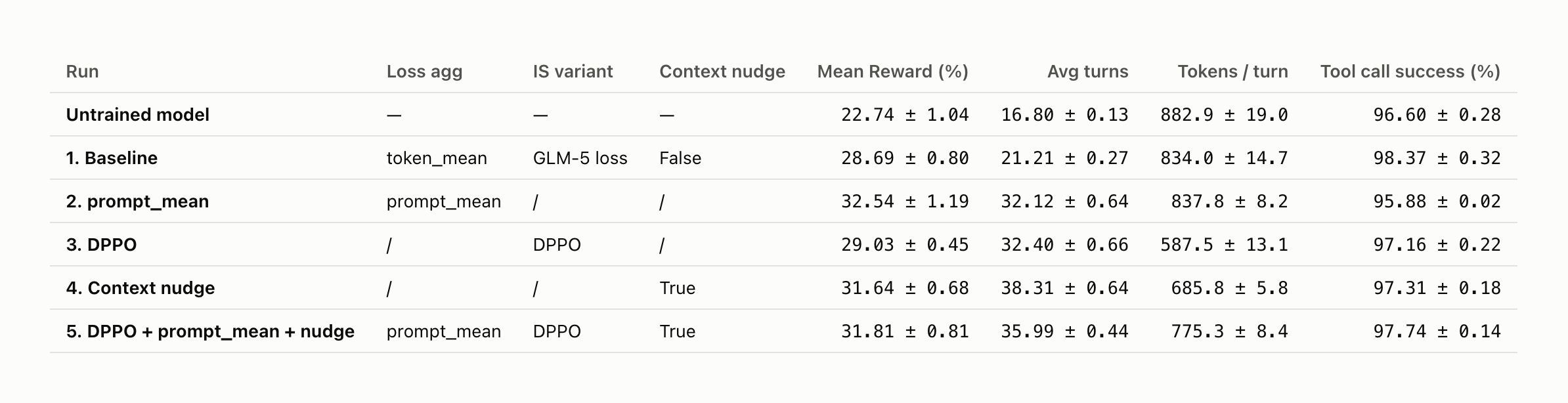
Table 1: Algorithm ablations on Qwen3.6-35B-A3B. Every run is evaluated at its epoch-1 checkpoint, 3 passes over the held-out 480 tasks (mean ± std). “/” means the same as baseline (token_mean, GLM-5 loss, no nudge). We performed additional experiments on adaptive length penalty, overlong filtering, and resetting KV-cache, but they did not significantly help. See the full experiment table here.
Absolute scores in this section are lower than our headline results, because we landed further Step-1 harness optimizations after the ablations. All runs within the ablation share the same harness, so comparisons here are apples-to-apples.
The knobs, and what we found:
- Token aggregation (+3.9 pts). There are three natural ways to aggregate the policy loss over a batch:
- Equally over every token (
token_mean, one global token pool, which is how token-level loss is implemented in most open frameworks; Dr. GRPO [14] is the equal-token variant that normalizes by a constant) - Equally over every sequence (
sequence_mean, as in original GRPO [15]) - Equally over every rollout group, and equally among tokens within a group (
prompt_mean, what DAPO’s objective [12] specifies, as ScaleRL [13] later highlighted)
- Equally over every token (
- Our trajectories range from 2k to 128k tokens, so
token_meanlets whichever prompts rolled out longest dominate the gradient.prompt_meanremoves that bias, and beats thetoken_meanbaseline by 3.9 points (run 4 vs. 1). - Policy loss, DPPO vs. GLM-5 loss. Both correct for train-inference mismatch and fully-async policy staleness by using the rollout logprobs directly in the loss, so neither needs the separate forward pass that traditional TIS [11] takes to obtain the trainer’s logprobs, a real saving at 100k-token trajectories. DPPO [8] masks tokens where training and inference logprobs diverge, via a binary approximation of total-variation divergence (we tried it after the positive report in the Tmax paper [1]); the GLM-5 loss (Section 3.3 of [10]) instead truncates the importance ratio. At epoch 1, the two score within noise of each other (run 3 vs. 1). DPPO’s clearest effect is on behavior rather than score: it consistently pushes the model toward more, shorter turns (21 → 32 turns; 834 → 588 assistant tokens per turn).
- Context nudge — a harness change that improves training. When 20% of the context budget remains, we inject a notice asking the model to wrap up. Fewer rollouts blow the context, so fewer get zeroed across the board, hence more usable signal per batch. And because it fires at a percentage rather than an absolute token count, it also absorbs the train-eval context-length mismatch slightly. All evaluations in this table run without the nudge, so its +3.0 points (run 4 vs. 1) is a pure training-time effect.
- What didn’t help (see the full table here): overlong filtering (OLF) and adaptive length penalty (ALP). OLF masks over-length rollouts out of the loss instead of penalizing them. Since we train at 160k and evaluate at 256k, not dramatically different, and both without compaction, we expected little benefit, and the ablation agrees: adding OLF cost 1.5 points, consistent with Composer 2’s finding [17]. ALP [16], with separate penalty coefficients for agent-generated vs. environment tokens, was neutral-to-negative at every setting we tried. Possibly our training horizon is too short for length pressure to pay off, or the coefficients need further tuning.
Two habits kept us honest when reading this table. First, single-pass evals over 480 tasks are noisy (±1–3 points run-to-run), so every number above is a 3-pass mean; treat differences within ~1 point as ties. Second, look at behavior, not just reward: many turns, few assistant tokens per turn, and high tool-call success suggest deliberate multi-step work rather than rambling. We have no rigorous justification for reading the table this way, but the runs that looked deliberate by these metrics were also the ones that scored best. We took run 5 (DPPO + prompt_mean + nudge) as the configuration for the hero run.
Step 5: The 397B hero run
After Step 4, we pick the knobs we are most confident in (DPPO + prompt_mean + the harness nudge, without length penalty or curriculum learning) and launch the 397B run.
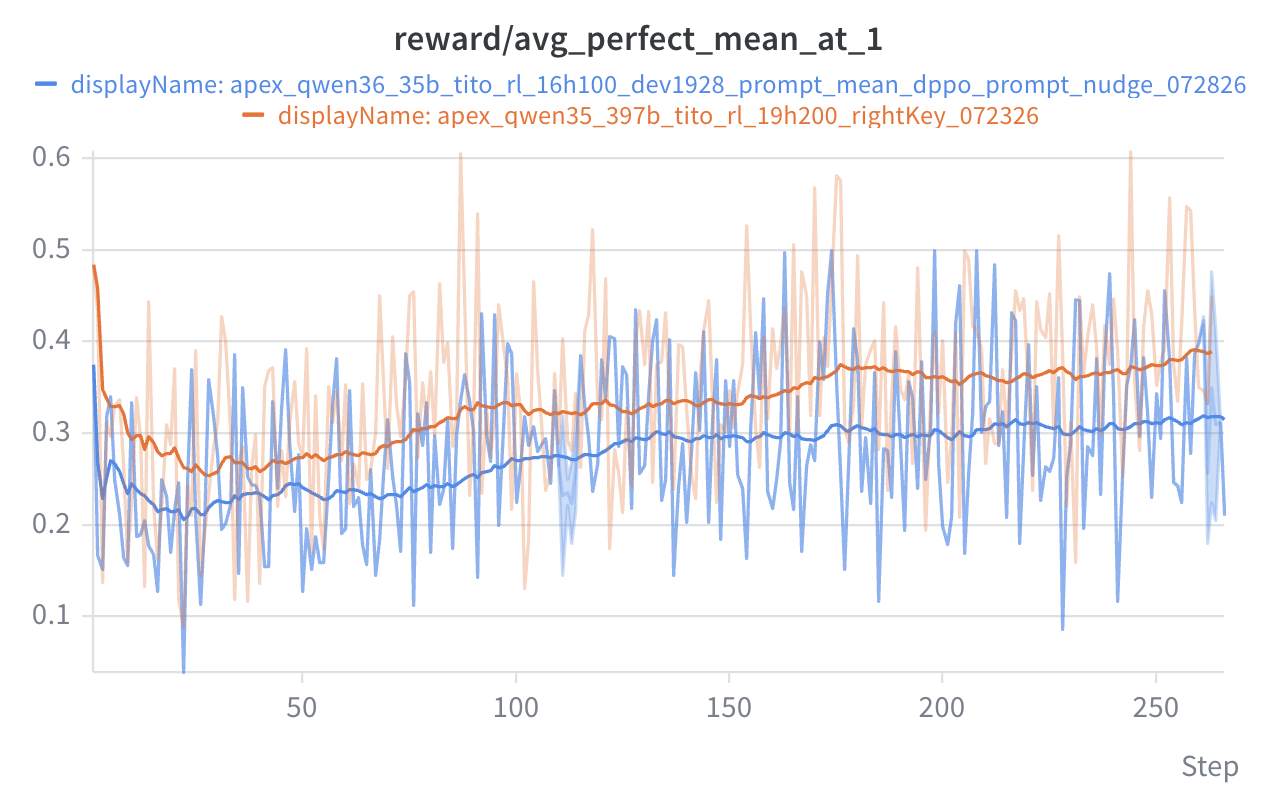
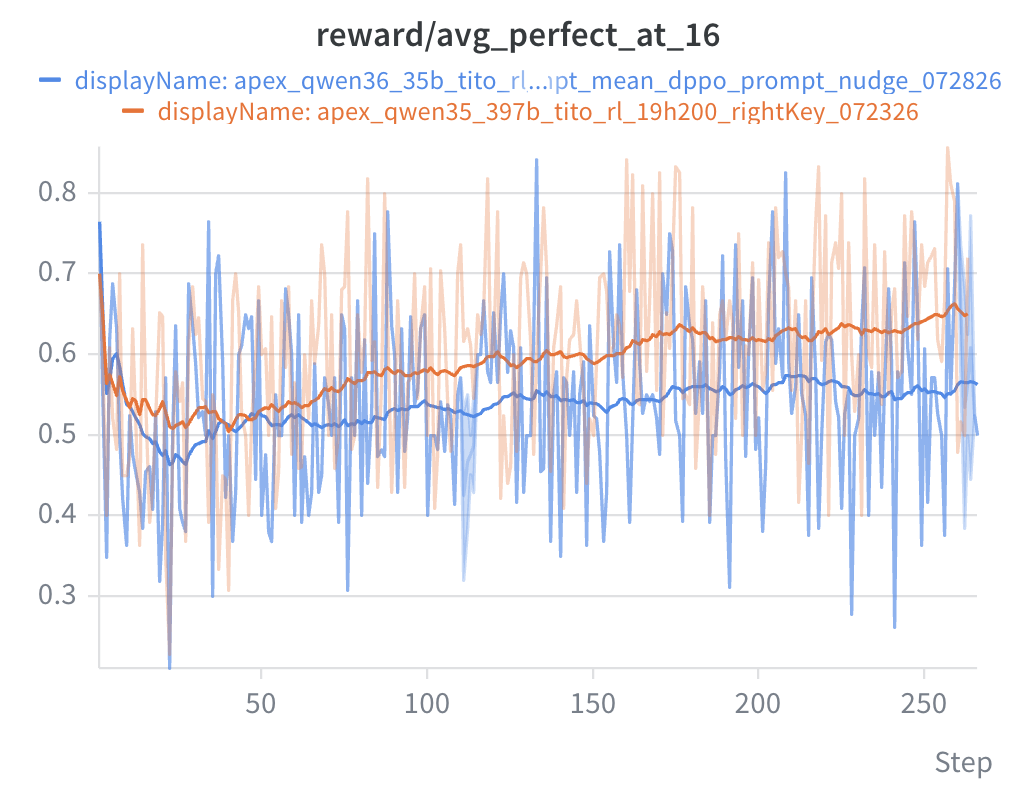
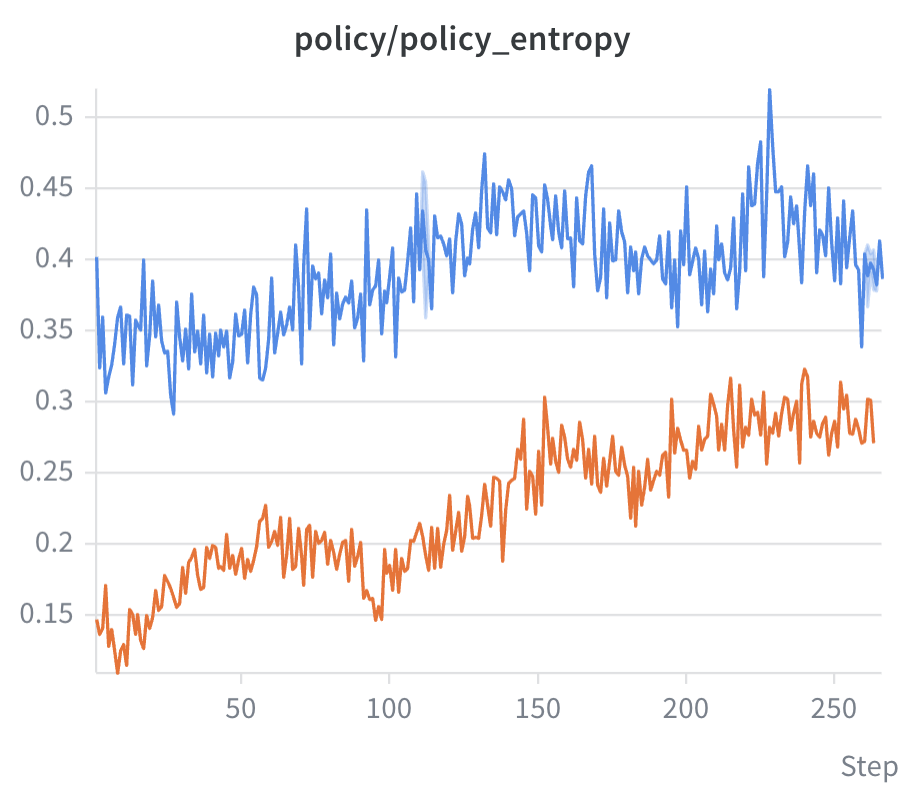
In our experience, the only real difference between a 35B run and a 397B run is the RL systems work, which Step 2 already de-risked. Below are the final Pass@1, Pass@16, and entropy curves for both runs. The initial drop in Pass@1 and Pass@16 are due to async RL dynamics, where easier tasks finish faster initially.
Step 6: Evaluation and generalization
Recent experience from the field suggests RL gains are bound to the harness they were trained in [9]. To test this, we swapped the MCP-based harness we trained on, Archipelago, for the popular code-based OpenCode, and evaluated on the same 480 APEX-Agents tasks. Under OpenCode we expose no MCP servers at all: we preinstall the Python packages the agent might need, and it works purely through code and file tools (bash, glob, read, grep, write, edit, todowrite).
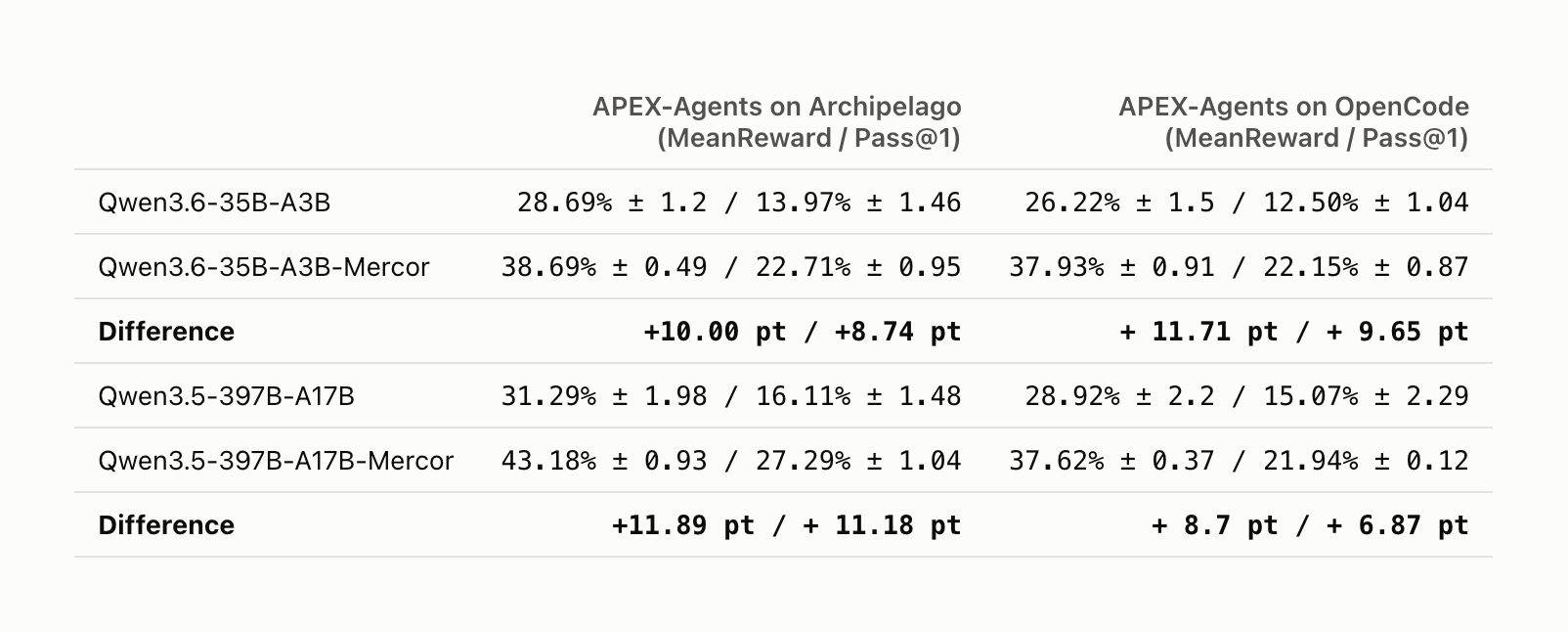
Table 2: APEX-Agents results under the harness we trained on (Archipelago) and a held-out harness (OpenCode).
The improvement largely transfers despite the harnesses being very different, and the 35B transfers noticeably better than the 397B. This is partly expected: over the course of training, Qwen3.6-35B-A3B learns to rely on code execution far more than on the MCP servers, while Qwen3.5-397B-A17B stays with MCP, possibly because Qwen3.6 received much heavier agentic post-training.
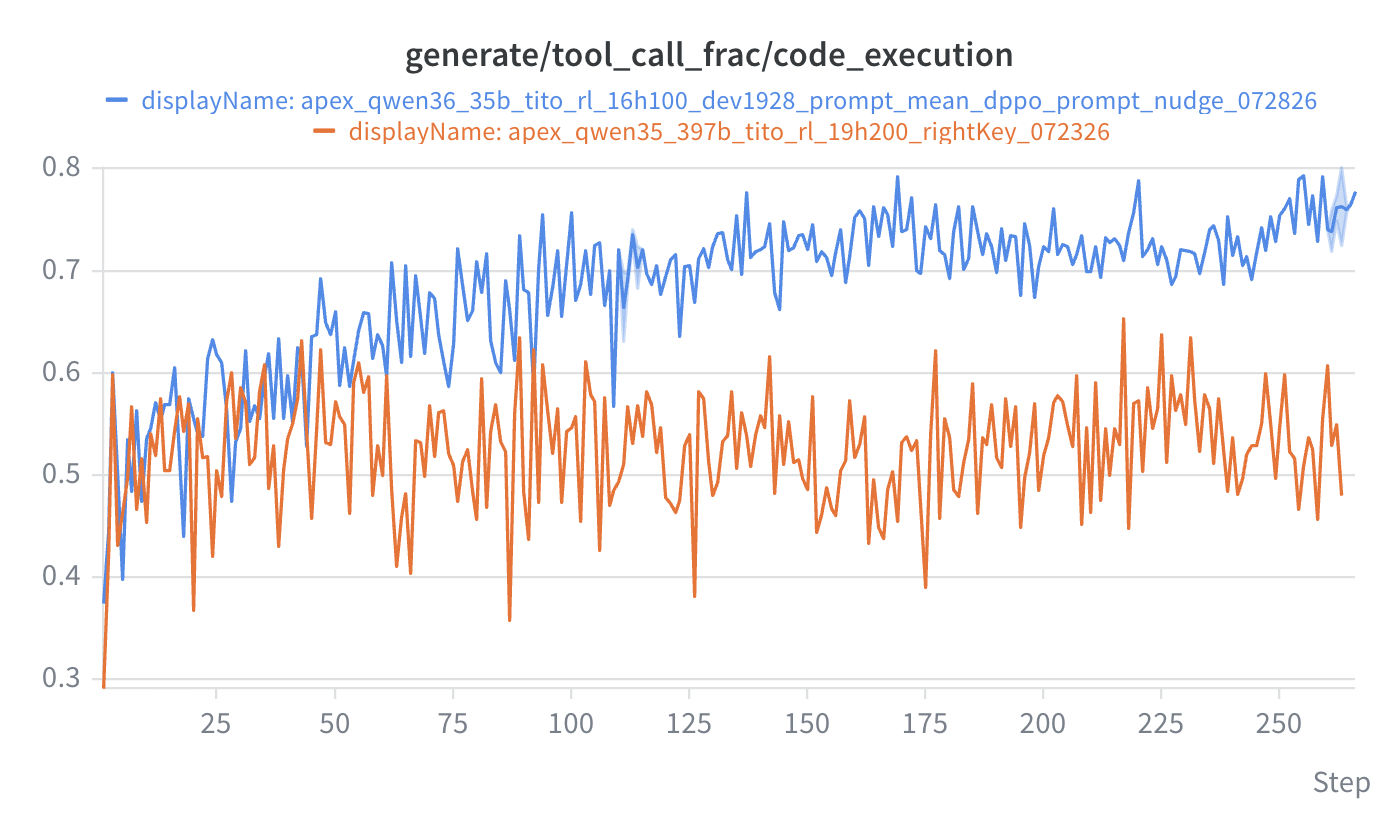
Figure 6: Fraction of tool calls that are code execution (vs. MCP tool calls). Qwen3.6-35B-A3B increasingly relies on code execution; Qwen3.5-397B-A17B keeps the same preference throughout.
To take a step further, we changed both the datasets and harness, evaluating Terminal-Bench 2.1 with Terminus, and found out our post-trained model generalizes to other agentic tasks as well. The small model again exhibits more transfer, which can likely be explained by its preference for code execution as well.
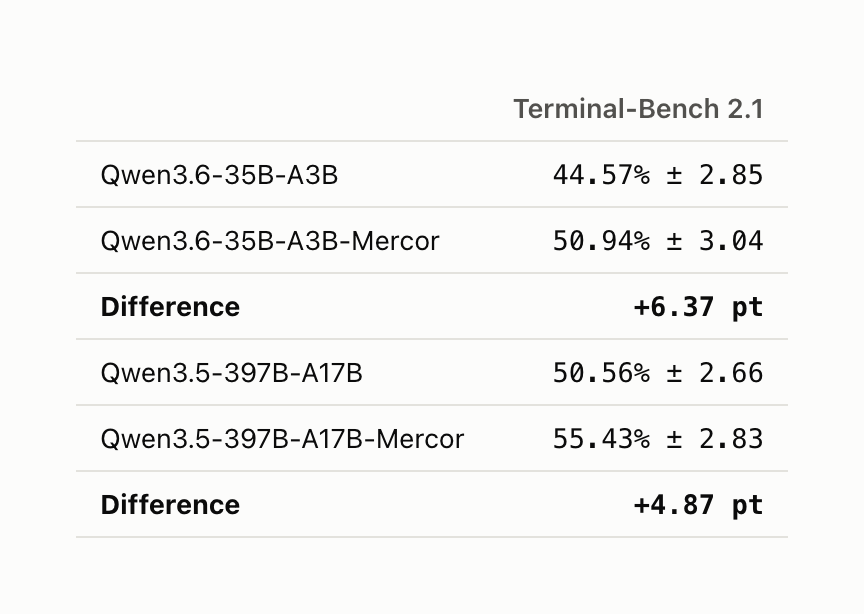
Table 3: Terminal-Bench 2.1 scores before and after post-training. These scores were computed over 3 passes using the terminus-2 harness. Every task had a maximum of 1000 steps, and 3 hour sandbox timeout. The baseline scores recreate the artificial-analysis reported scores as Qwen3.6-35B-A3B at 44.6% and Qwen3.5-397B-A17B at 50.6%, within the error-bounds.
In addition to APEX-Agents and Terminal-Bench 2.1, we evaluated HLE and GPQA to ensure the model did not lose non-agentic reasoning capabilities. Numbers below are reported over 3 passes.
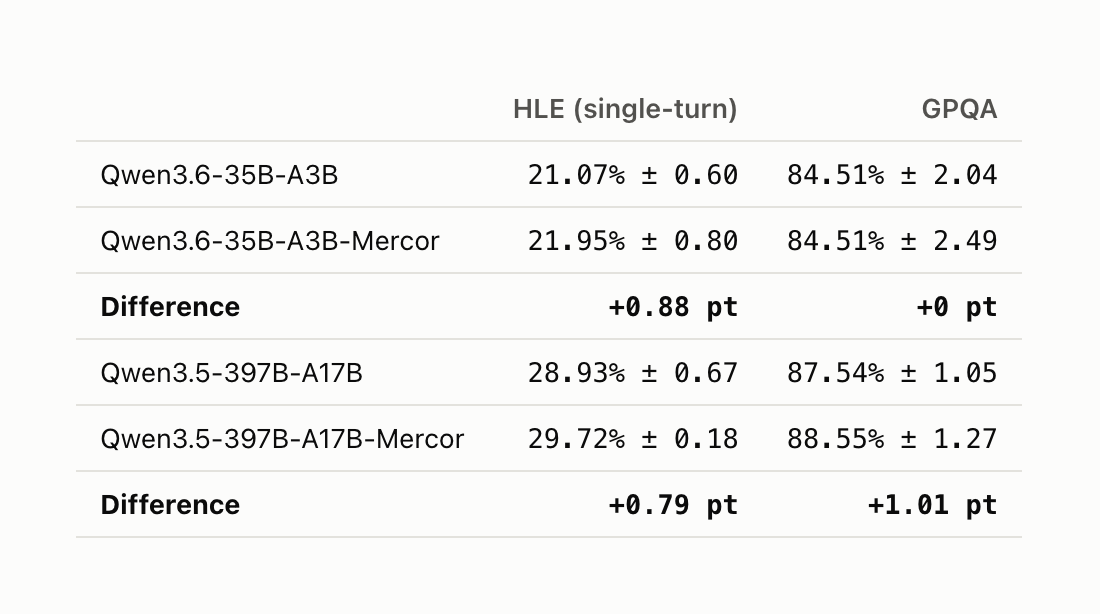
Table 4: HLE and GPQA, before and after post-training. All differences fall inside the error bars, so we read this as no regression rather than an improvement.
Lessons and forward-looking
Two things stood out. Algorithm choices mattered less than the data: the best of five knobs gave +3.9 points, while post-training as a whole moved both models 10 to 12 points. And the gains transfer across harnesses, suggesting a post-trained open model is a reusable asset rather than something welded to one scaffold. We expect the next stretch of the gap to frontier to close from the data side.
Step 1’s de-risking surfaced a number of improvements to the APEX-Agents dataset itself, which we will share in APEX-Agents v1.1. We will also apply this playbook to more off-the-shelf datasets and share our learnings. On the data side, Mercor is investing further in trace analysis, since understanding where models improve and where they fail informs which new data yields the most return.
On the framework side, SkyRL is landing several improvements so that users can do as little of Steps 1–2 as possible. A TITO proxy is coming soon (issue), and thanks to SkyRL’s Tinker-first design, we aim to make the same training loop and agent integration run on any Tinker-compatible compute backend, including managed services (issue).
The training script is at github.com/Mercor-Intelligence/ApexAgents-SkyRL-Recipe, and the model weights and eval traces are in the ApexAgents-SkyRL-Recipe Hugging Face collection. The 480 APEX-Agents tasks are on Hugging Face if you want to run the benchmark yourself.
As we move forward, we plan to extend our open training runs to more frontier datasets and more capable models. Our modeling research team tackles problems like better learning algorithms for knowledge work, model customizability, as well as the automation of domain-specific post-training. We envision a future where we enable every enterprise to easily customize open models on proprietary data to then unlock more economic value.
We are expanding the Mercor Research team, join us.
Acknowledgements
This work was done by Charlie Ruan*, Sumanth Hegde, Eric Tang, Tyler Griggs, Jungyeon Park, Maanas Baraya, Philipp Moritz, Michael Haines, Edward J. Hu, and others on the Mercor Research and SkyRL teams. We thank Anyscale for helping set up the training cluster. We thank Nathan Lambert, Lifan Yuan, Kourosh Hakhamaneshi, and Hamish Ivison for helpful feedback on the blogpost.
* Work done at Mercor Research.
Citations
[1] https://arxiv.org/abs/2606.23321
[2] https://www.together.ai/blog/deepswe
[3] https://arxiv.org/abs/2601.14242
[4] https://vllm.ai/blog/2025-10-22-agent-lightning
[5] https://huggingface.co/blog/huggingface/tito
[6] https://arxiv.org/abs/2505.24298
[7] https://arxiv.org/abs/2509.19128
[8] https://arxiv.org/abs/2602.04879
[9] https://arxiv.org/abs/2607.24653
[10] https://arxiv.org/abs/2602.15763
[11] https://fengyao.notion.site/off-policy-rl
[12] https://arxiv.org/abs/2503.14476
[13] https://arxiv.org/abs/2510.13786
[14] https://arxiv.org/abs/2503.20783
[15] https://arxiv.org/abs/2402.03300