What is an AI trainer?
An AI trainer is someone who reviews and improves the answers that AI systems produce. Instead of building the technology itself, they focus on making sure the responses are accurate, helpful, and appropriate for real people.
You can think of them as the “human quality check” behind AI. They look at what the AI says and decide things like: Is this correct? Does it actually answer the question? Is anything misleading or unsafe? Would someone trust this response?
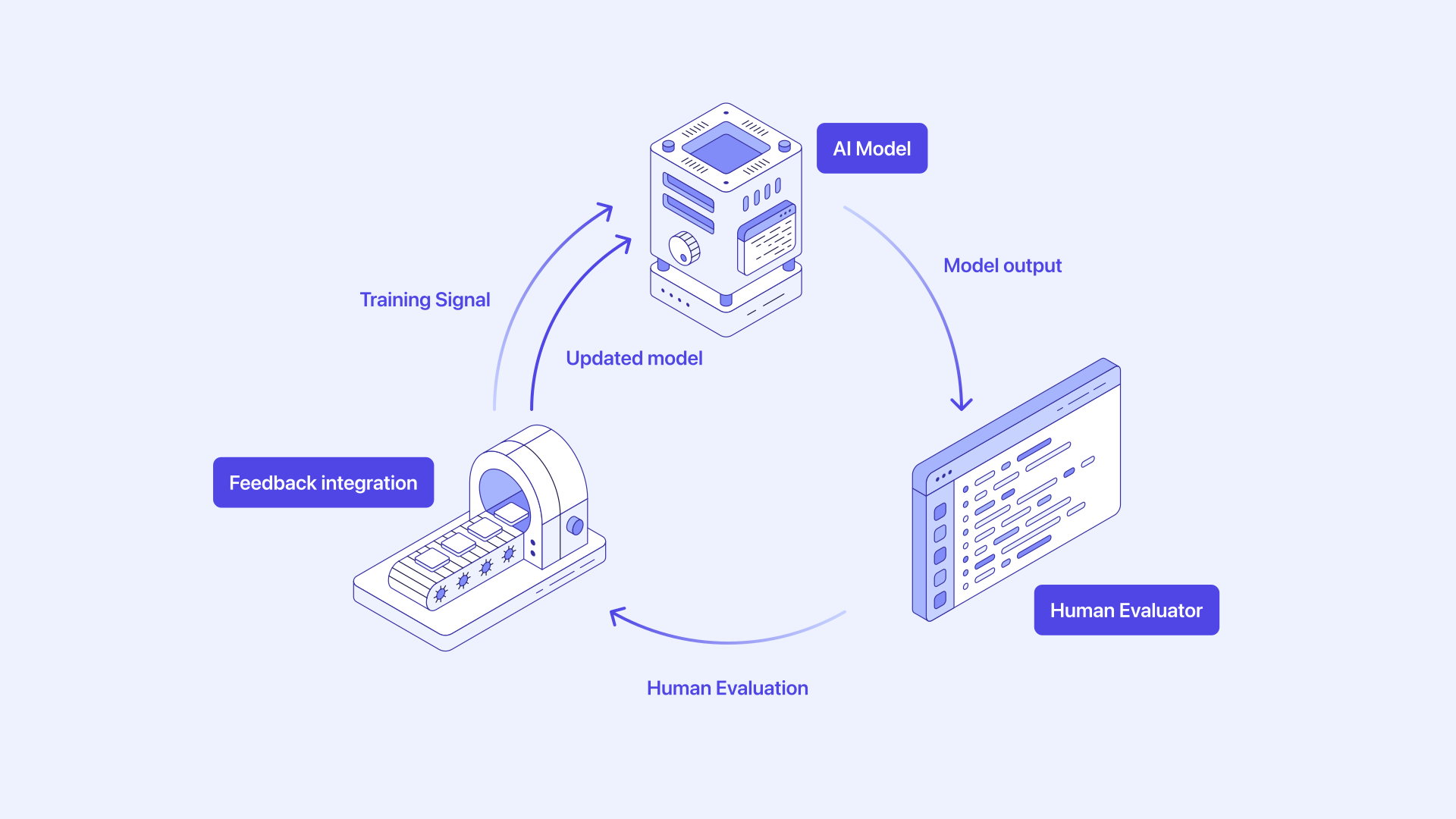
The feedback AI trainers give is then used to improve the system, which is typically a machine learning (ML) model, a type of software that learns patterns from data instead of being explicitly programmed, making it better over time in a few key ways.
- First, it helps teach the model what “good” looks like. When trainers mark answers as correct or incorrect, the model learns from those examples and starts to improve its future responses.
- Second, it helps the model learn preferences. When trainers compare two answers and pick the better one, the model begins to understand what people actually prefer, not just what is technically correct.
- Finally, trainers help test and double-check the model before it’s widely used. They make sure it meets quality standards and catch common mistakes so they can be fixed early.
In simple terms, AI trainers help teach the model, guide its behavior, and make sure it’s ready for real-world use.
AI trainers are distinct from ML engineers and data scientists. ML engineers build and fine-tune model architectures, while AI trainers focus on input quality and output evaluation. They’re the human layer that teaches AI systems how to be better.
What does an AI trainer do?
Most AI training work follows a similar rhythm: reviewing the rubric, completing tasks, documenting reasoning, passing quality checks, and making adjustments when guidelines shift.
A typical project cycle looks like this:
1) Onboarding and calibration
- You review project-specific instructions and labeling guidelines.
- You complete a small set of calibration tasks.
- A reviewer compares your work to the project standard and resolves any discrepancies.
2) Task execution
- You work through a queue: labeling, ranking, scoring, or critiquing.
- You write brief justifications when the task requires explanation.
- You flag ambiguous cases for review instead of making guesses.
3) Quality review
- Platforms track agreement with gold standards, consistency over time, and adherence to policy constraints.
- If you’re a high performer, you’ll typically receive access to more complex queues, while low consistency can restrict your access to work.
4) Guideline iteration
- Projects tend to shift as they progress. Rubrics get updated or edge cases are clarified.
- The best trainers can adapt quickly without deviating from the standard.
This work is typically remote and asynchronous, providing real flexibility. Trainers engage in sustained close reading, microdecisions, and disciplined writing.
How much can you make as an AI trainer?
Earnings can vary quite a bit depending on the type of work you do, your level of expertise, the platform you work on, and whether you’re doing this part-time or as a full-time role. Location can also play a role. Some platforms adjust pay based on where you’re based, while others offer the same rates globally, especially for specialized or high-skill work.
Here’s a simple breakdown of how pay typically scales:

- Foundational tasks (labeling, basic review): Around $12–$25/hour. This work is usually more repetitive and can vary depending on project availability.
- Evaluation and feedback work (comparing answers, explaining decisions): Around $25–$50/hour. This requires stronger judgment, clear writing, and consistency.
- Specialized or domain expert work (medical, legal, finance, etc.): Around $60–$100+/hour. These roles pay more because they rely on real-world professional expertise and higher accountability.
- Full-time roles (AI training specialist, model evaluator): Typically around $80K/year or more. These roles usually require a strong track record of high-quality work, consistency over time, and the ability to handle more complex tasks or take on ownership.
One important factor that often gets overlooked is time commitment. Even if hourly rates look attractive, your total earnings depend heavily on how much consistent work you can access and how many hours you’re able to dedicate. Some platforms have fluctuating task availability, so steady income often comes from building a strong reputation and getting access to better, more consistent projects.
Because of this variation, it’s important to look beyond just the hourly rate when evaluating opportunities. Things to pay attention to include:
- How consistent is the work week to week?
- Are you paid for onboarding or training time?
- Does good performance unlock higher-paying work?
- How are changes in guidelines handled mid-project?
- How many hours can you realistically commit?
Overall, AI training is legitimate, paid work used by real companies. What you earn largely depends on the level of skill, judgment, and reliability you bring, along with how consistently you engage with the work.
What skills and qualifications do you need to become an AI trainer?
You don't need a computer science degree for most AI trainer roles. However, you do need disciplined reasoning, clear writing, and the ability to follow standards consistently, especially when the answers aren't obvious.
Core skills that span specializations
- Rubric discipline: Applying rules consistently, even when the content is complex
- Written clarity: Explaining why an output fails in a concise and logical way
- Critical thinking: Spotting hidden assumptions, logical gaps, and subtle errors
- Attention to detail: Having the ability to catch a single mistake in an otherwise "good" answer
- Comfort with ambiguity: Escalating edge cases instead of improvising new rules
What changes as you move up the ladder
- From labeling → evaluation: You move from simply checking answers to making more thoughtful decisions. This means comparing responses, explaining which one is better, and backing up your reasoning clearly.
- From evaluation → rubric design: You go from following guidelines to helping create them. This means thinking about what “good” looks like at a system level and setting clear standards that others can use to judge AI responses consistently.
Do you need a degree or certification to be an AI trainer?
Usually, you don't need a specific degree to become an AI trainer. Many roles use assessments to test skills such as writing quality, rubric application, and accuracy over time. The path to becoming an AI trainer typically hinges on demonstrated skills rather than credentials.
However, credentials do matter for:
- Domain-expert work: Licenses and advanced degrees, such as MD, JD, CPA, PE, and PhD, often signal credibility in fields where the cost of mistakes is high. For example, a doctor evaluating medical AI outputs or a lawyer reviewing contract analysis needs recognized professional standing.
- Full-time roles inside enterprises: Many such roles list a bachelor's degree as a baseline requirement, even when the day-to-day work involves evaluation and documentation.
While AI trainer certification programs exist, there is no universal standard. More beneficial is often a strong track record of consistent evaluation quality, clear written rationales, and the ability to work through ambiguous cases without deviating from the rubric.
If you’re wondering how to break into AI training without a background in the field, the most direct path is to:
- Build core skills: Practice writing clear explanations, evaluating arguments, and following complex guidelines.
- Start with entry-level projects: Begin with annotation or evaluation work to establish a quality track record
- Specialize gradually: Choose projects that align with your existing domain knowledge to build up a specialism.
If you’re looking for steps on how to get started, check out our detailed guide on how to become an AI trainer.
What is the demand for AI trainers, and what are the career paths?
Demand for AI-related work is growing as businesses invest in AI systems, data processing, and software development. The U.S. Bureau of Labor Statistics projects ongoing growth in computer and mathematical occupations through 2034, driven in part by increasing demand for AI and data-driven applications. This broader shift is creating more opportunities for roles that support, evaluate, and improve AI systems.
Many people wonder whether AI training qualifies as legitimate work that’s worth pursuing. The answer depends on what you're looking for. For those seeking flexible remote work without a technical degree, it's a genuine entry point. For those building toward AI careers, it's a stepping stone that teaches you how models work, where they might fail, and how human feedback shapes behavior.
How you can advance in AI training
If your goal is to build a long-term career, not just complete tasks for income, prioritize work that helps you build transferable skills. Here’s what that progression typically looks like:
| Starting Role | Progression Path | Key Responsibilities |
|---|---|---|
| Model evaluator | Evaluation lead | Owns rubrics, calibration, reviewer consistency, and evaluation metrics |
| Domain trainer | Domain quality specialist | Owns standards, risk flags, and escalation paths for high-stakes outputs |
| Trainer | AI QA/AI operations | Tracks regressions, runs test suites, and manages feedback loops after deployment |
| Trainer with technical growth | Data analyst or ML-adjacent roles | Leverages Python, basic statistics, or experiment design skills |
Professionals who understand model behavior, data quality, and evaluation methodology are becoming increasingly essential to AI teams. AI talent platforms such as Mercor connect skilled professionals with companies building the next generation of AI products.
Which industries need AI trainers the most?
Industries where precision, safety, and in-depth domain knowledge matter most show the strongest demand for specialized AI trainers. As AI systems move beyond general-purpose chatbots into regulated, high-stakes domains, the need for human oversight increases.

Healthcare and Life Sciences
Medical AI systems need trainers who grasp:
- Clinical reasoning and differential diagnosis
- Medical terminology and documentation standards
- The safety implications of incorrect outputs (e.g., diagnostic errors and treatment recommendations)
Healthcare institutions developing AI tools for radiology, clinical documentation, drug discovery, and patient triage actively seek professionals with medical backgrounds to evaluate model outputs.
Legal and Compliance
Lawyers, paralegals, and compliance professionals are among the most sought-after AI trainers because their domain knowledge is difficult to replicate. Legal practices and technology providers developing AI systems need professionals who can:
- Evaluate contract analysis for accuracy and completeness
- Review legal research outputs for citation accuracy and reasoning
- Assess compliance risk in automated document reviews
This level of domain knowledge is critical, as even small mistakes can expose organizations to serious legal and financial consequences.
Finance and Accounting
Financial institutions using AI for fraud detection, risk assessment, and financial analysis need specialists who understand:
- Financial modeling conventions and industry-specific calculations
- Regulatory requirements (such as those established by the Financial Industry Regulatory Authority)
- Risk assessment frameworks and when AI outputs violate standards
Technology and Software Development
Tech companies building code generation tools, debugging assistants, and developer platforms need trainers who can:
- Evaluate code quality, security, and efficiency
- Identify edge cases in programming logic
- Test model performance across languages and frameworks
Software engineers often move into AI training roles focused on code evaluation because they bring the experience needed to assess generated code.
Education and E-Learning
EdTech companies developing AI tutors and adaptive learning systems need trainers who grasp:
- Pedagogical best practices and learning science
- Age-appropriate content and explanation styles
- Curriculum alignment and assessment validity
Professionals with teaching or instructional design experience bring real-word context that these roles require.
Customer Service and Conversational AI
Companies deploying chatbots, virtual assistants, and customer support automation need specialists who can:
- Evaluate tone, empathy, and appropriateness of responses
- Identify customer frustration patterns and escalation triggers
- Test edge cases in multiturn conversations
Many customer service professionals move into AI chatbot trainer roles because they already understand what makes interactions succeed or fail.
What are the biggest misconceptions about AI Trainer roles?
| Misconception | What's True Instead |
|---|---|
| AI training is just data entry | While some foundational work resembles data processing, the work that improves real systems relies on interpretation and careful judgement. This involves evaluating reasoning, detecting subtle errors, and documenting why something fails. |
| You need to be a programmer | Many roles don't require coding knowledge. Instead, they look for writing skills, logical reasoning, domain knowledge, and consistency. Technical literacy helps, but it's rarely the main requirement for most training tracks. |
| AI will replace AI trainers soon | Parts of the workflow will become automated, especially repetitive labeling tasks. But systems that involve money, health, safety, or rights will still need human oversight for evaluation, bias review, and domain accuracy. The role will evolve, but it won’t disappear. |
| AI training is a scam or not legitimate work | AI training is real, paid work used by leading AI labs. Legitimate platforms do exist, so scrutinize opportunities carefully, but don't write off the field entirely. |
| There’s no future in this kind of work | AI training work can evolve over time as you take on more responsibility. Growth comes from increasing responsibility, while staying at simpler tasks can limit long-term opportunities. As you move beyond basic tasks and take on work that involves judgment, quality standards, and domain expertise, you can access more consistent opportunities and increase your earnings. |
Is AI training right for you?
AI training can be a strong fit if you enjoy thinking critically, paying attention to detail, and explaining your reasoning clearly. Much of the work involves reviewing content closely, spotting small issues, and making judgment calls, so it suits people who are comfortable working independently and following guidelines consistently.
It’s also a good option if you’re looking for flexible, remote work or a way to get closer to the AI space without needing a technical background. That said, entry-level work can feel repetitive, and task availability may vary depending on the platform. Over time, the people who get the most out of this work are those who build their skills and move into more advanced, higher-responsibility tasks.
If this sounds like a fit, the next step is understanding where to find these opportunities and how to evaluate them.
Where can you find AI trainer roles?
You can find AI training work through specialized platforms that coordinate projects for AI companies, facilitate direct contracts with product teams, and advertise full-time positions with titles such as model evaluator, AI quality specialist, or data quality analyst.
At Mercor, we connect professionals across fields like software engineering, healthcare, law, finance, and writing with AI training projects, by matching your expertise to the needs of leading AI labs. If this resonates, feel free to explore our AI trainer opportunities. We’re currently looking for professionals across a range of fields to contribute.
How to evaluate opportunities
Not all opportunities are created equal. Look for the following criteria to help you differentiate legitimate platforms from time-wasters:
- No upfront fees: Legitimate opportunities don't require you to pay to access work.
- Clear time commitments: The platform should outline project duration, expected weekly hours, and overall workload so you can plan accordingly.
- Transparent payment terms: You should understand when you will get paid, for what, and how disputes are handled.
The goal isn't to accept just any AI training task. It's to find a feedback environment where quality gets rewarded and your judgment compounds. Many freelance AI trainer opportunities start as contract work but can evolve into ongoing relationships or full-time positions as you build credibility.
Key takeaways for an AI Trainer
If you're exploring AI training, start with a simple question: Do you want flexible task work, or do you want a skill-building career path that compounds?
- Flexible task work: Choose reputable projects with clear guidelines and consistent pay practices. Focus on platforms with responsive support.
- If your goal is to grow in this field: Focus on evaluation work that requires clear reasoning, helps you understand how feedback improves AI systems, and builds a track record of strong judgment over time.
As AI keeps getting better at generating answers, the human focus has shifted to deciding which answers deserve trust and why. That's the essence of an AI trainer’s role.
Mercor connects professionals across industries such as software engineering, law, healthcare, writing, and finance with AI training projects at leading labs and enterprises. If you’re interested in contributing your expertise to AI advancement, explore current opportunities on Mercor.