What workers want to hand to AI, and what they want to keep

Last month, we introduced TaskNet with researchers from Mercor, Stanford, O*NET Resource Center, and the National Bureau of Economic Research. TaskNet builds on the structure of O*NET, the US Department of Labor's widely used map of occupational tasks.
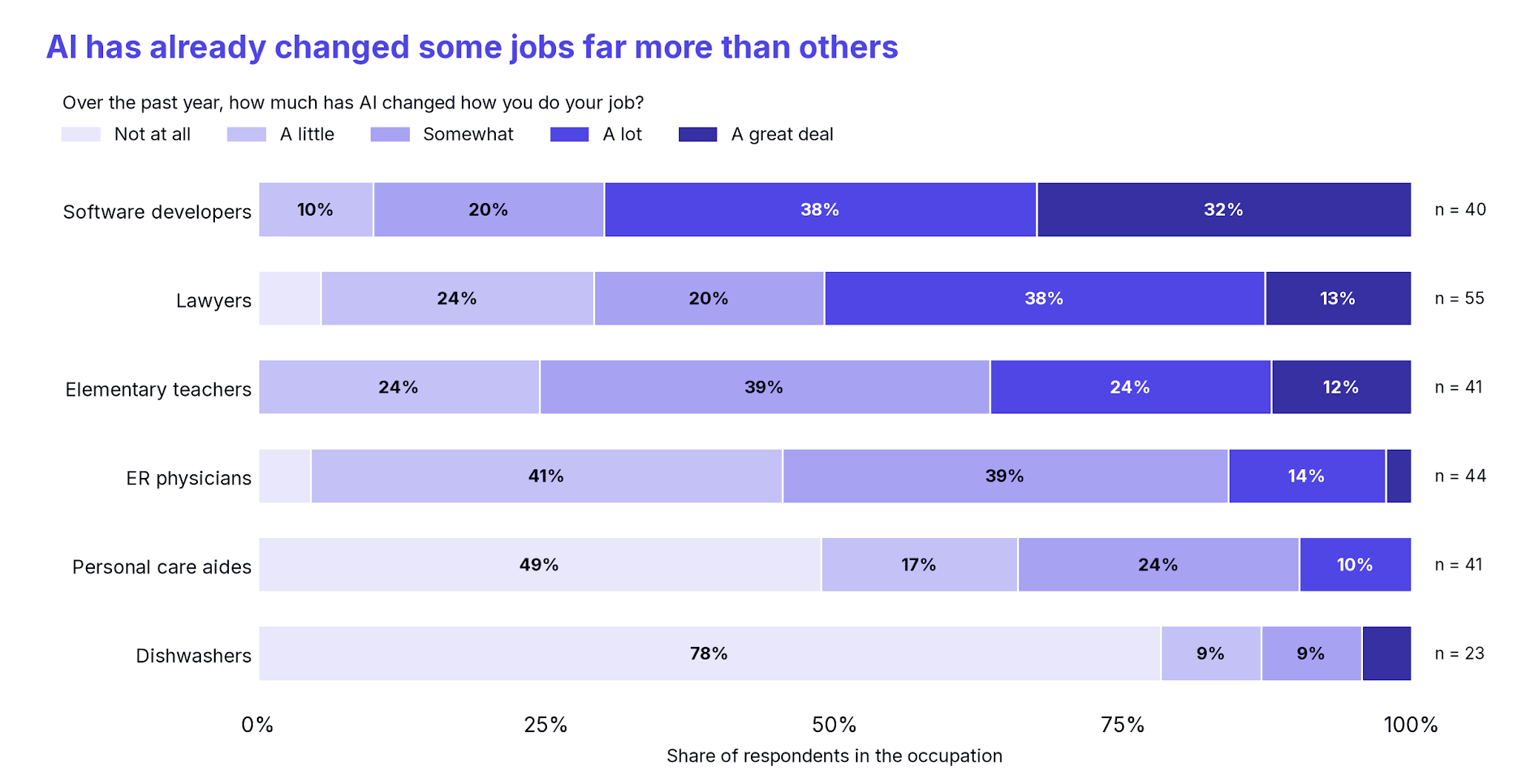
From TaskNet and our conversations with workers, we learned that AI is changing some jobs more than others, that exposure scores might be higher than we initially thought, and that the tasks outsiders associate with an occupation often differ from the ones insiders see as core to it. The missing piece was asking these workers how they felt about AI progress and how they would shape it going forward.
Following work by WORKBank (Shao et al., 2025), Bick, Blandin, Deming and Schumacher and others, we surveyed more than 200 participants from our original TaskNet study about how AI has changed their jobs, which tasks they see as core to their occupation and how they view its future.
Running the survey
Each worker received a survey listing their occupation's TaskNet tasks. Drawing on the WORKBank survey (Shao et al., 2025), respondents rated every task they do on several scales, including how much they would want an AI system to do the task for them if it could do it completely (not at all to entirely), how much they enjoy the task, setting salary aside; and how much human-AI collaboration the task would need if AI assisted (none needed to essential).
Workers could then pick the tasks they would most like AI to take over and the ones they most want to keep doing themselves, with a sentence on why. Finally, they answered three questions about the job as a whole: how much AI has changed how they do their job over the past year, what they would most likely do with the time freed up if AI took over the tasks they would like automated, and how they feel about AI’s effect on their occupation over the next five years.
Exposure scores track reported change
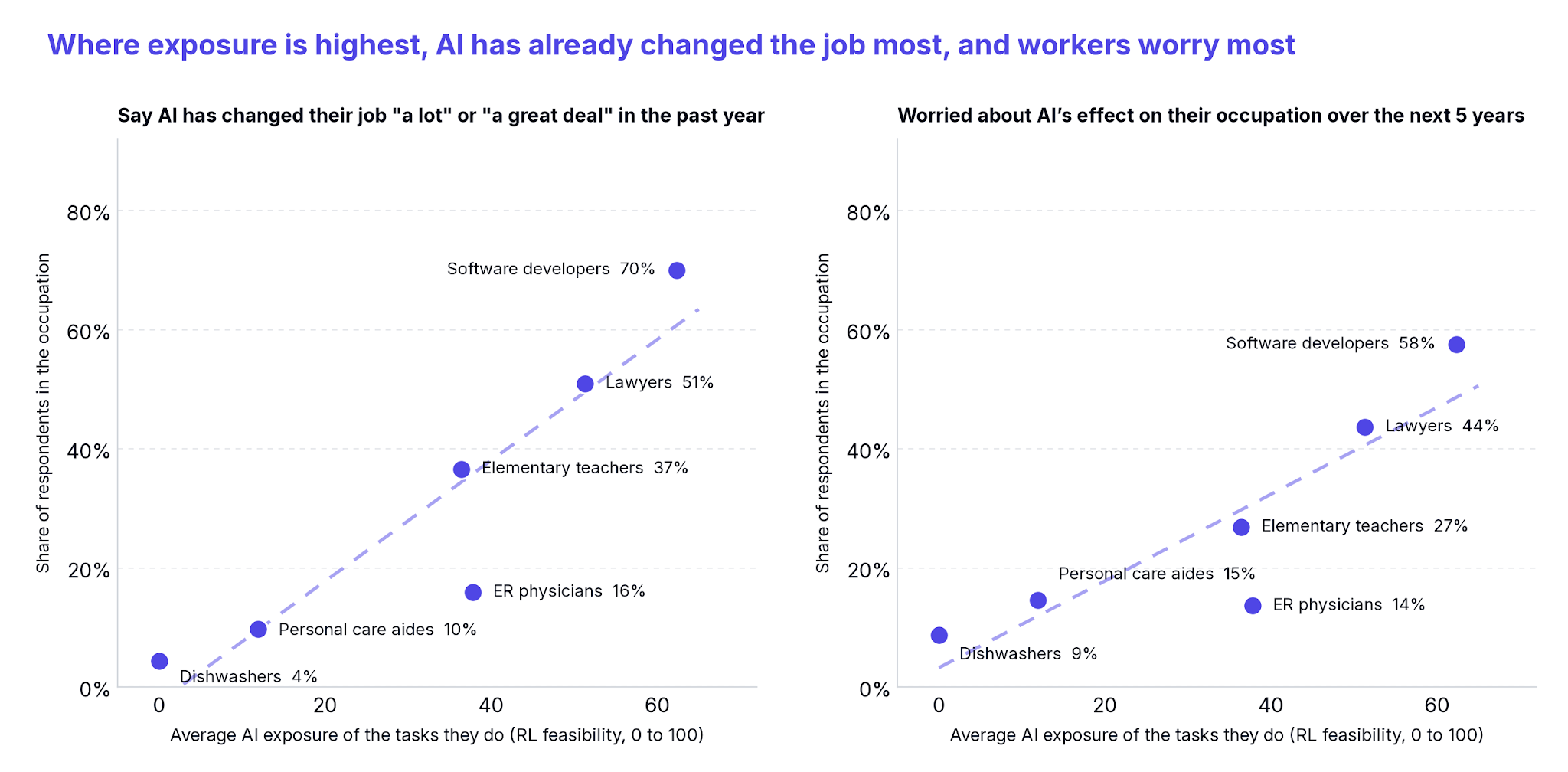
Each TaskNet task gets a score from 0 to 100 for how feasible it would be to build a training environment where AI can practice the task and learn from feedback, following the methodology set out in What Jobs Can AI Learn? Measuring Exposure by Reinforcement Learning.
We found that people in more exposed occupations were much more likely to say AI has changed their job a lot in the past year, and to worry about AI's effect on their occupation's future. ER physicians were a notable exception, placing lower on both axes than their exposure score would suggest. These trends hold even when we weight by importance or time and are robust to different exposure measures, such as that found in Eloundou et al.¹
Where workers think human involvement matters
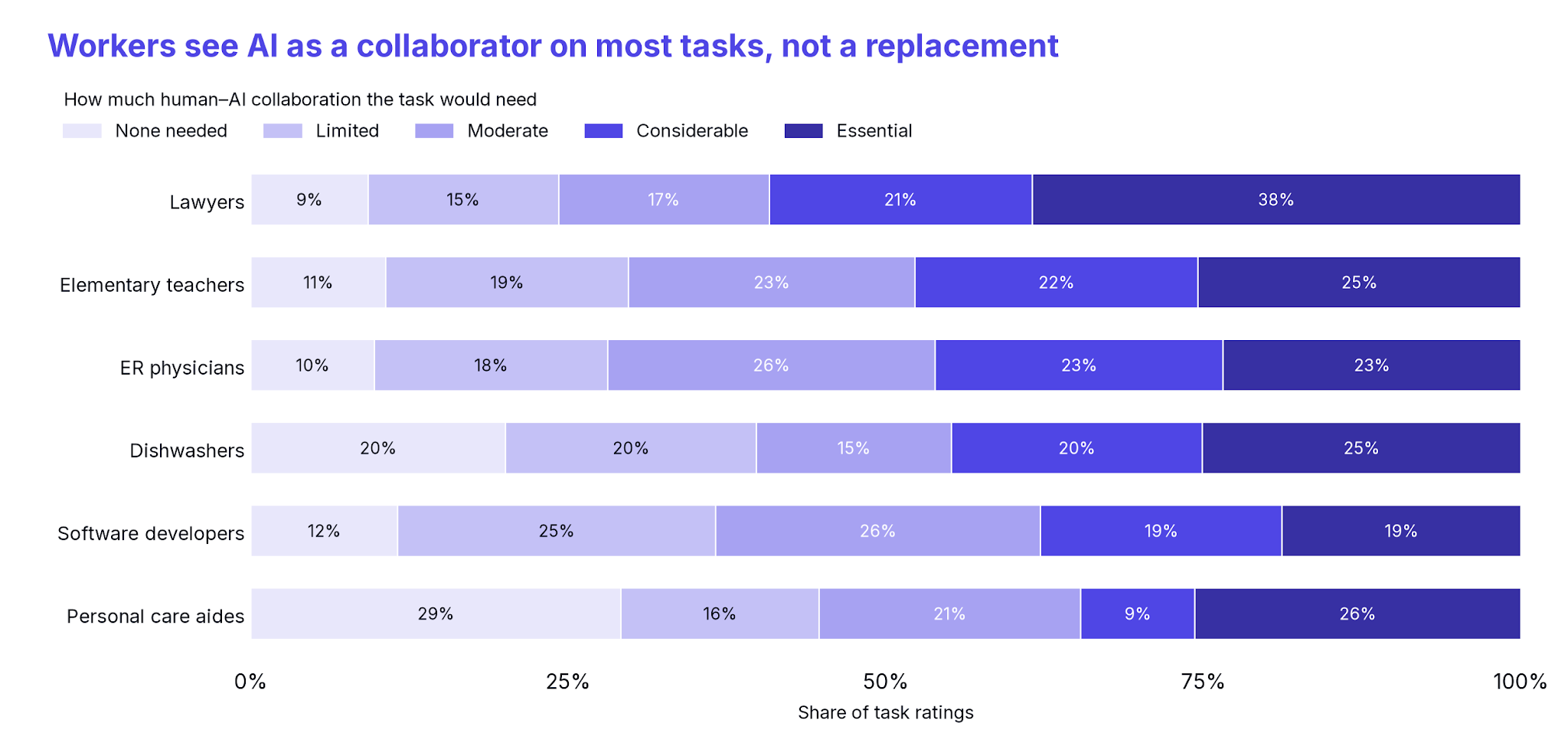
For each task, we asked how much human-AI collaboration it would need if AI helped with it. Of roughly 9,000 task ratings, 14% were "none needed" and 27% "essential," with most somewhere in between.
"I would like AI to listen to my patient encounter and show me a list of tests to approve based on the discussion. I do not want it to autonomously order the tests without my approval."
- ER physician
Lawyers gave "essential" most often, for 38% of their task ratings, compared with 19% for software developers. Many tasks rated essential involve important decisions:Atlassian's survey of 1,013 US knowledge workers similarly found that 78% of workers want humans leading high-risk decisions, and 3% would let AI make them alone.
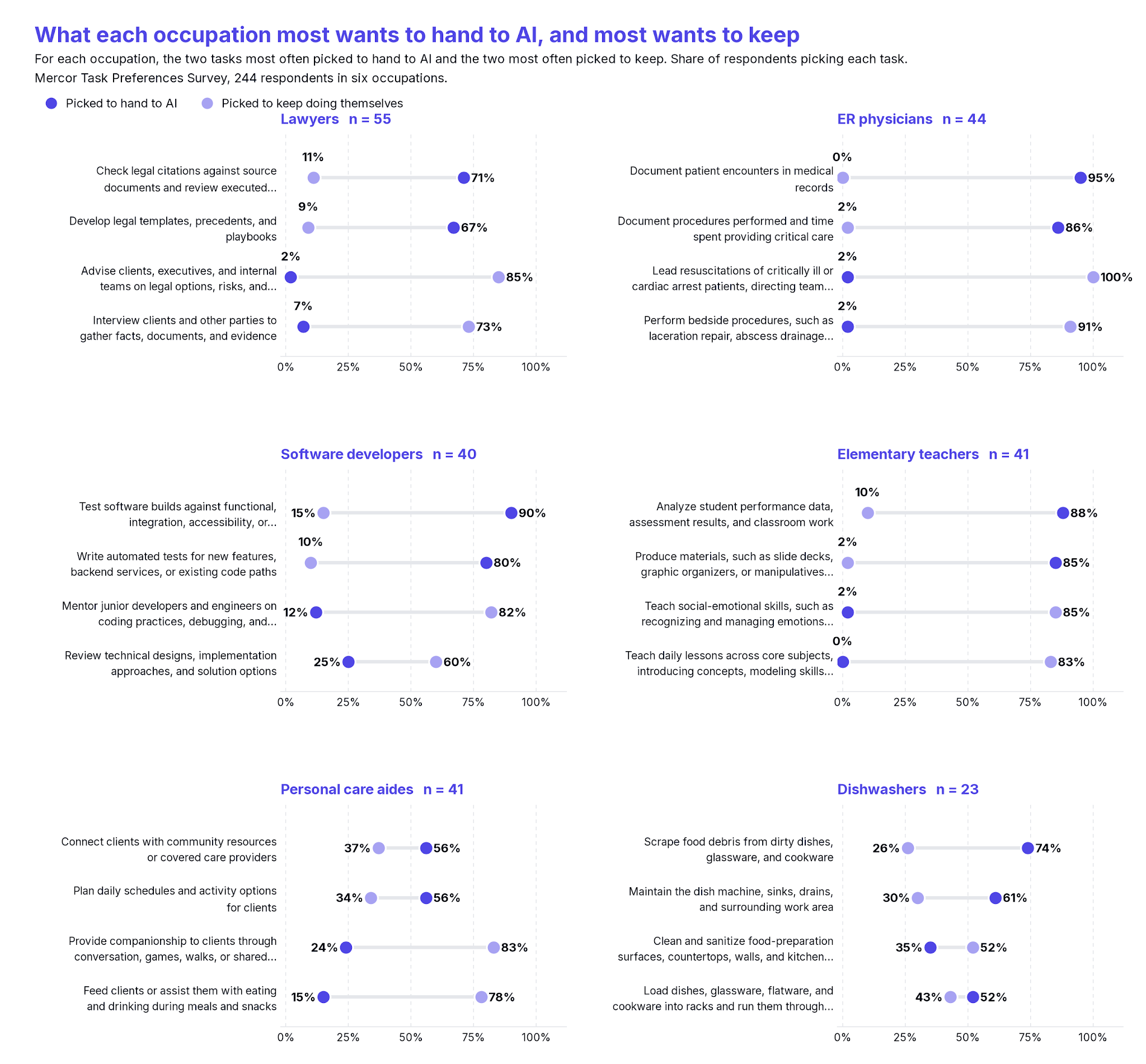
More broadly, workers want to keep tasks that are relational or high-stakes. For software developers, that means mentoring junior developers or reviewing technical designs; for physicians, leading resuscitations; and for lawyers, interviewing clients and advising them on risks and options.
The tasks that were most likely to be handed to AI were often clerical, like testing software builds for software developers or keeping medical records up to date for ER physicians. Teachers showed some of the starkest splits: most want to hand data analysis and material production to AI but keep teaching daily lessons and helping kids with emotional skills.
What workers would do with the time saved by AI
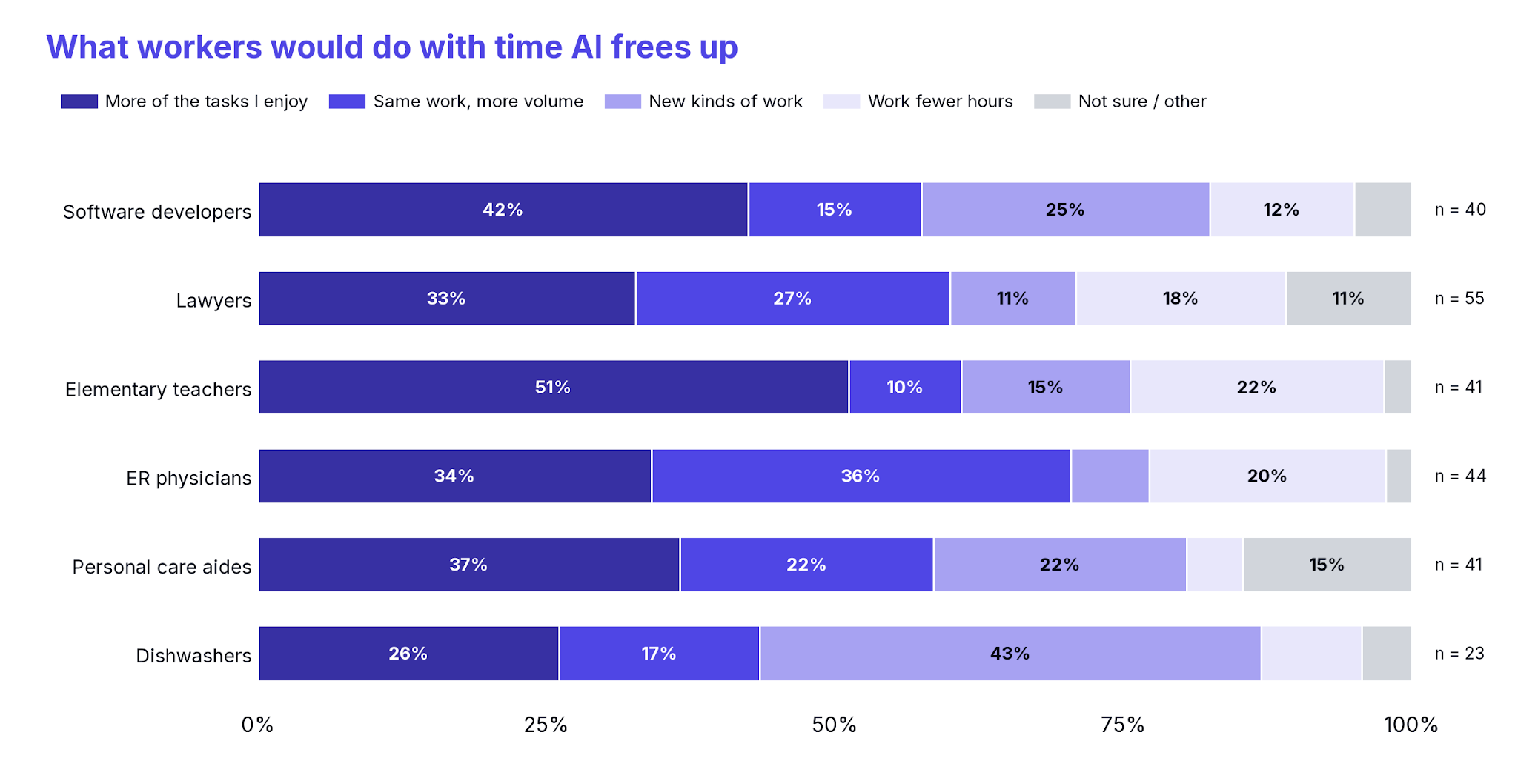
Asked what they would do with time saved by AI, 38% of respondents said they'd do more of the tasks they enjoy; 22%, the same work at higher volume; 18%, move into new kinds of work; and 15%, work fewer hours. That roughly matches Gallup's 2026 survey of 7,845 US employees who use AI at work, 47% said it lets them spend more time on the most interesting parts of their job, and 31% said their employer had asked them to take on more responsibilities as a result.
Elementary school teachers were the most drawn to the work they enjoy (51%); as one of them put it, AI "would allow me to be more present in my classroom and do a better job directly teaching my students." ER physicians were the most inclined to do the same work at higher volume (36%), and dishwashers to move into new kinds of work (43%).
Extending the survey to the whole network
In mid-October, we began offering everyone who completes a Mercor application an optional module on AI and the future of work. Responses came from over 4,000 workers, spanning many more occupations.
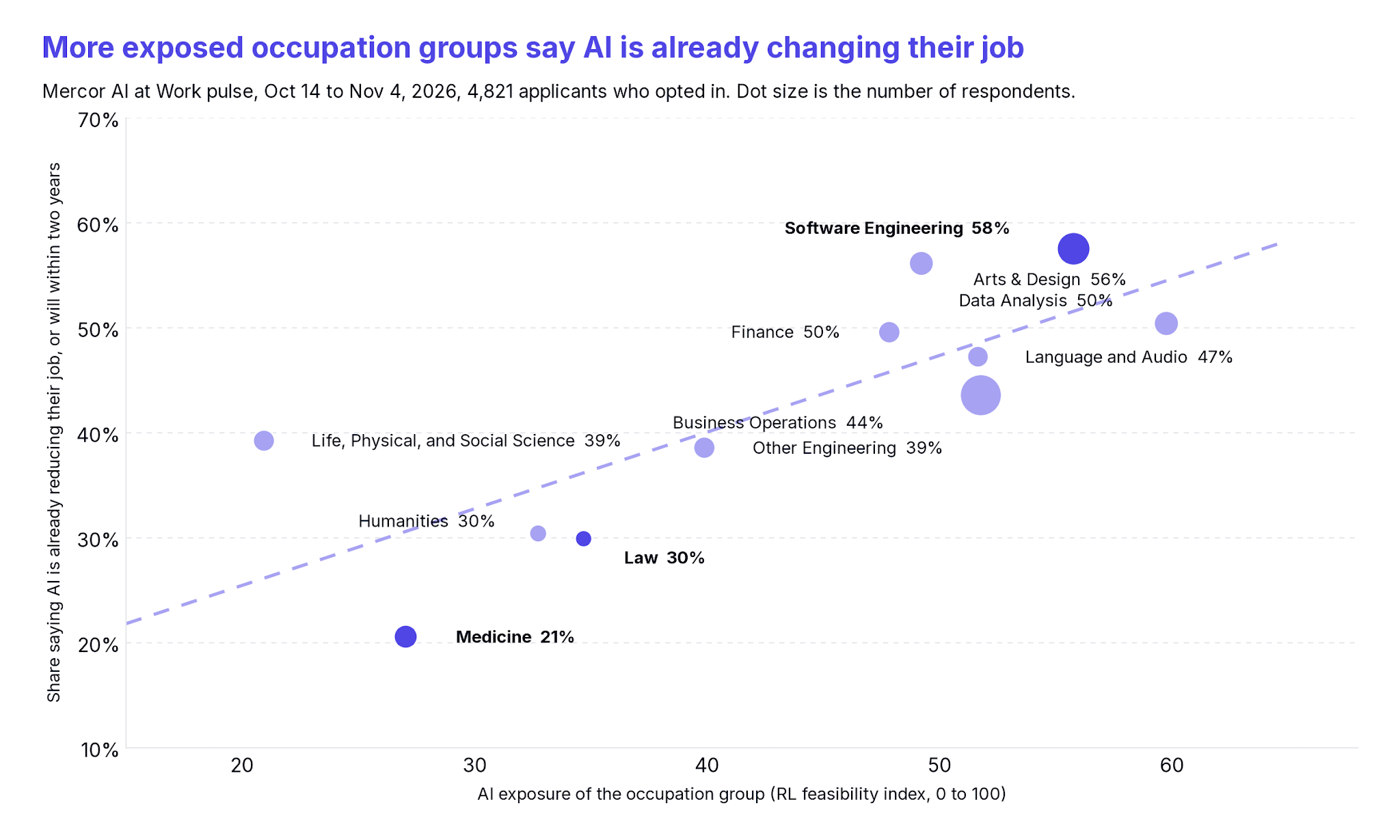
The link between exposure scores and how much people say AI has affected their jobs holds across this broader set of occupations, with medicine again noticeably below where the trend line would suggest. We note that people on our platform are significantly more likely to be interested in and engaging with AI, and expect this to heavily bias our sample. An earlier version of the same module, adapted from the Real-Time Population Survey, found that 82% of those reporting on a job outside Mercor already use generative AI for it, against 45% nationally.
Conclusion
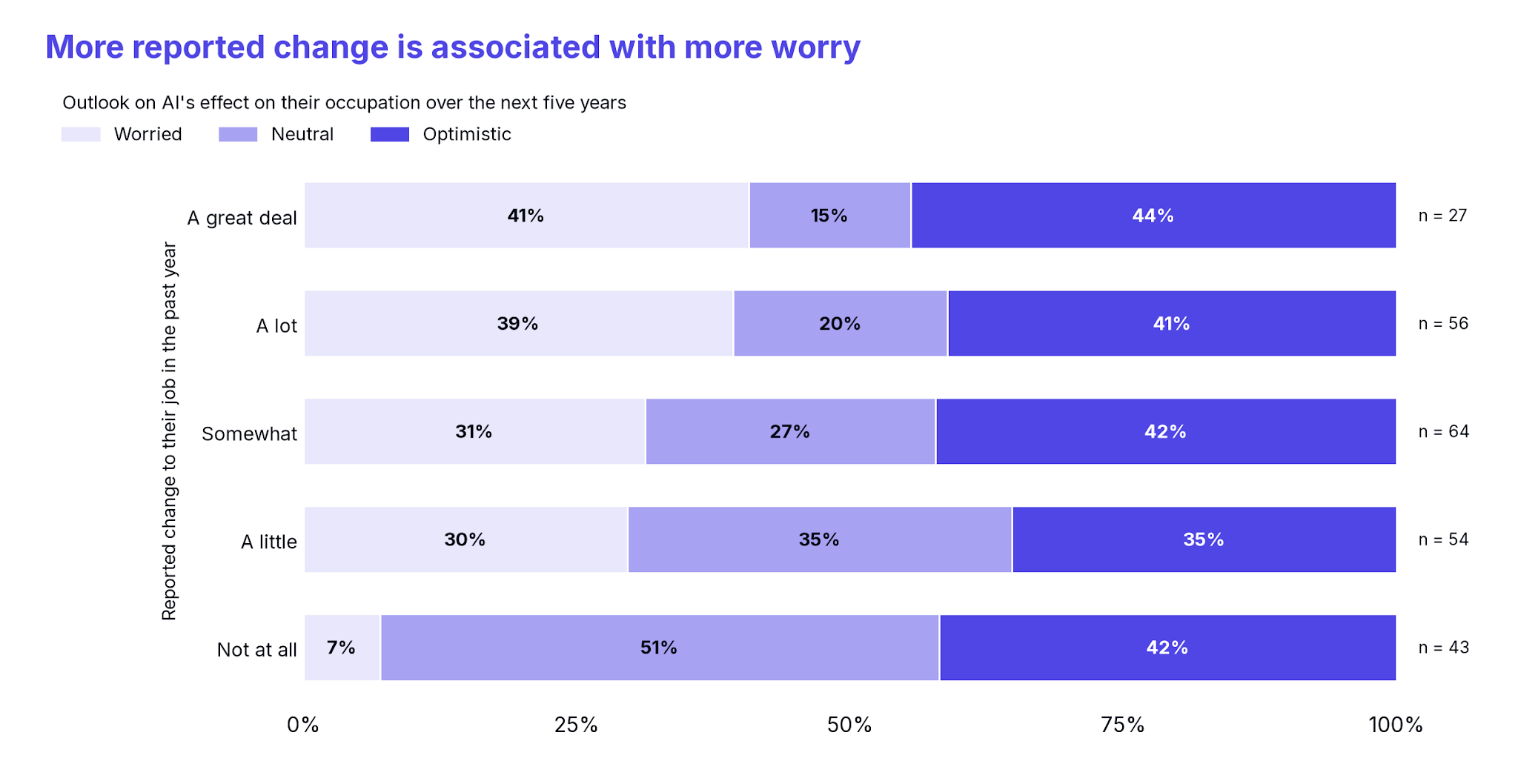
Looking across occupations, people who rated their jobs as having changed more were much more likely to be worried than people who rated their job as having not changed much at all. The share who are optimistic, however, holds steady across levels of change. What shrinks is the share who feel neutral, which suggests views of AI may polarize as it spreads.
AI is a technology that we built for humans, and it's a technology that has been built off of the collective knowledge of humans. Mercor has built a platform that allows occupational experts to help train AI tooling. That same platform, though, can be used to understand what those workers want from AI in that occupation. Through TaskNet and associated surveys, we hope to increasingly understand how workers see AI fitting into their role, where they don't see it fitting into their role, and how to tell the difference between the two.
Appendix: exposure under Eloundou-β
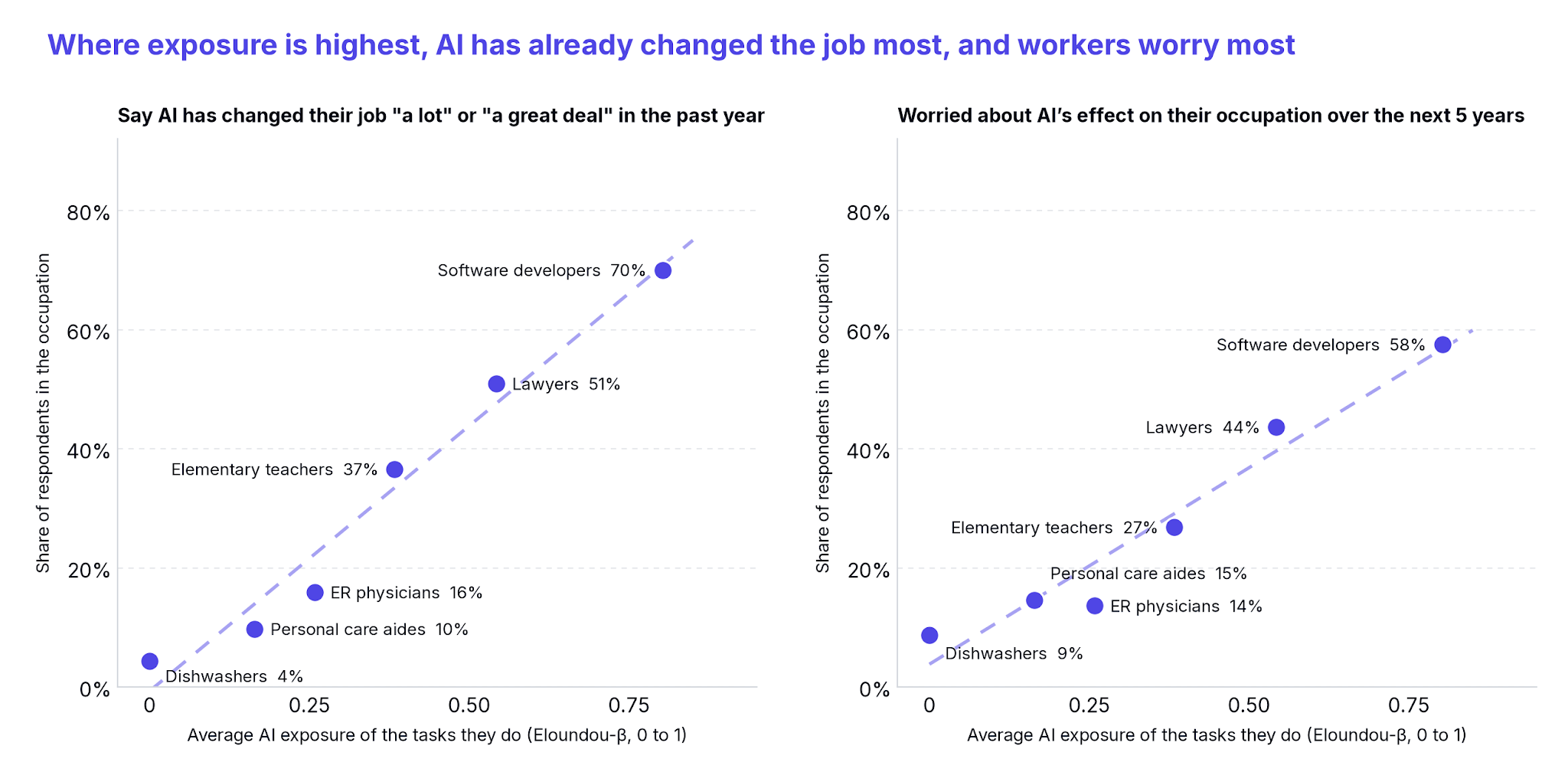
¹ Bick et al. find that exposure scores explain some, but far from all, of the variation in generative AI adoption across occupations and tasks, and Lindenlaub, Oh, Rodriguez and Veldkamp, using a representative German worker survey, find that an exposure-only model explains 14% of the variation in adoption across occupations, against almost 60% for an index that adds AI's comparative advantage over the worker.