Your Company Is Sitting on a New Asset: Its Data

How the everyday record of your company’s work is becoming a new source of revenue in the AI economy.
Every company produces a detailed record of how work gets done. It shows the decisions and escalations, the handoffs between teams, and what broke and how your team fixed them. That record lives in your email, your Slack, your documents, your tickets, your code, and the systems each team runs on. Most companies treat it as a storage cost.
Mercor has paid over $50 million for it.
Why enterprise data Is becoming valuable now
For years, AI development has relied heavily on publicly available information, including websites, books, code, and other digital content. As AI moves beyond generating content toward completing real tasks, developers increasingly need examples of how work happens inside organizations.
Consider an ordinary work day. Consider a sales operations workflow. An SDR might need to identify an account in Salesforce, review recent conversations in Gmail, retrieve relevant context from Notion, update a forecast, and notify the appropriate team. An engineer might move between GitHub, Postgres, and Slack to resolve an incident. A recruiter might coordinate across Ashby, Slack, and Rippling to bring a new employee onboard. Each of those workflows are full of decisions and interactions that are difficult to reconstruct from public information alone.
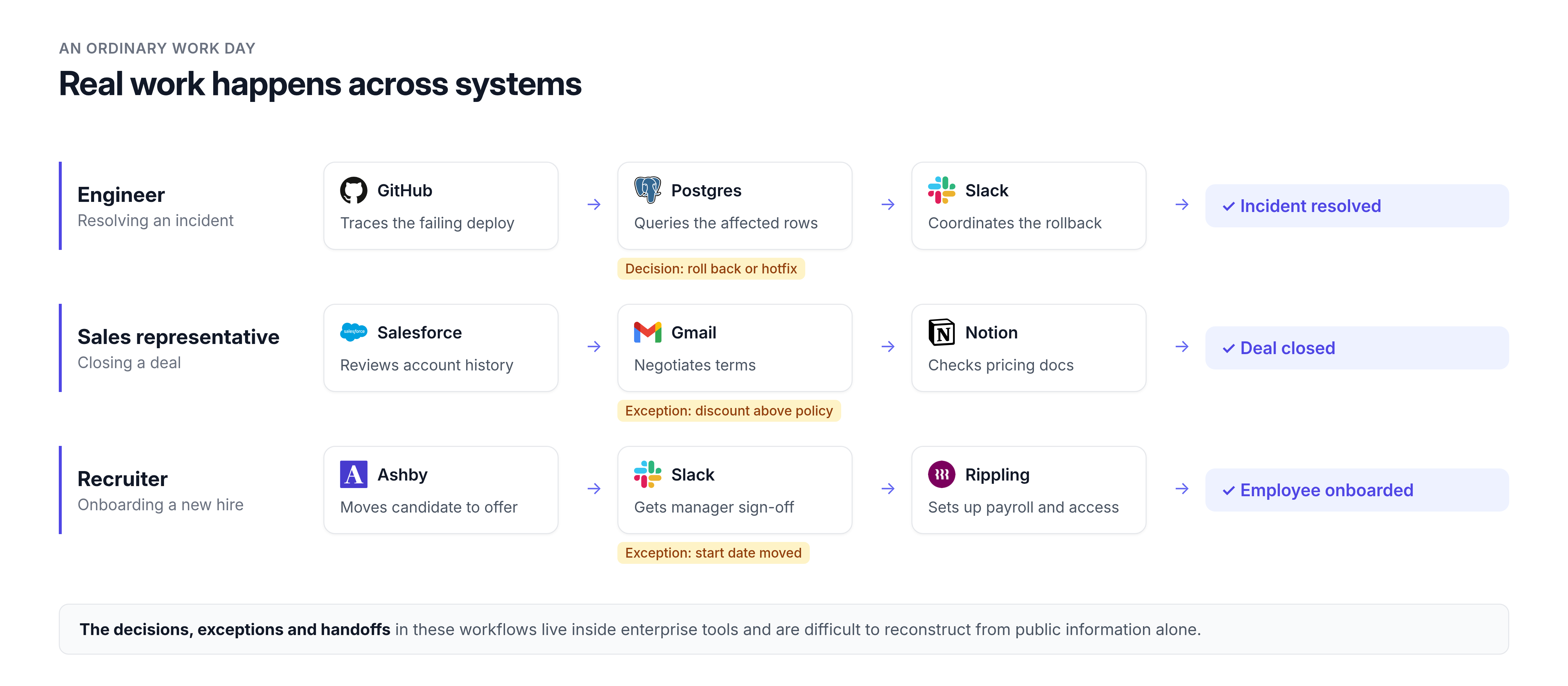
This shift is creating demand for proprietary enterprise data across the AI ecosystem, from developers building foundation models to companies developing specialized agents and enterprise applications. The challenge is that much of this information is fragmented across systems, difficult to extract, and contains sensitive business or personal information. Even companies that see the value rarely have the infrastructure to process it or commercial relationships to price and bring it to market.
Mercor has both.
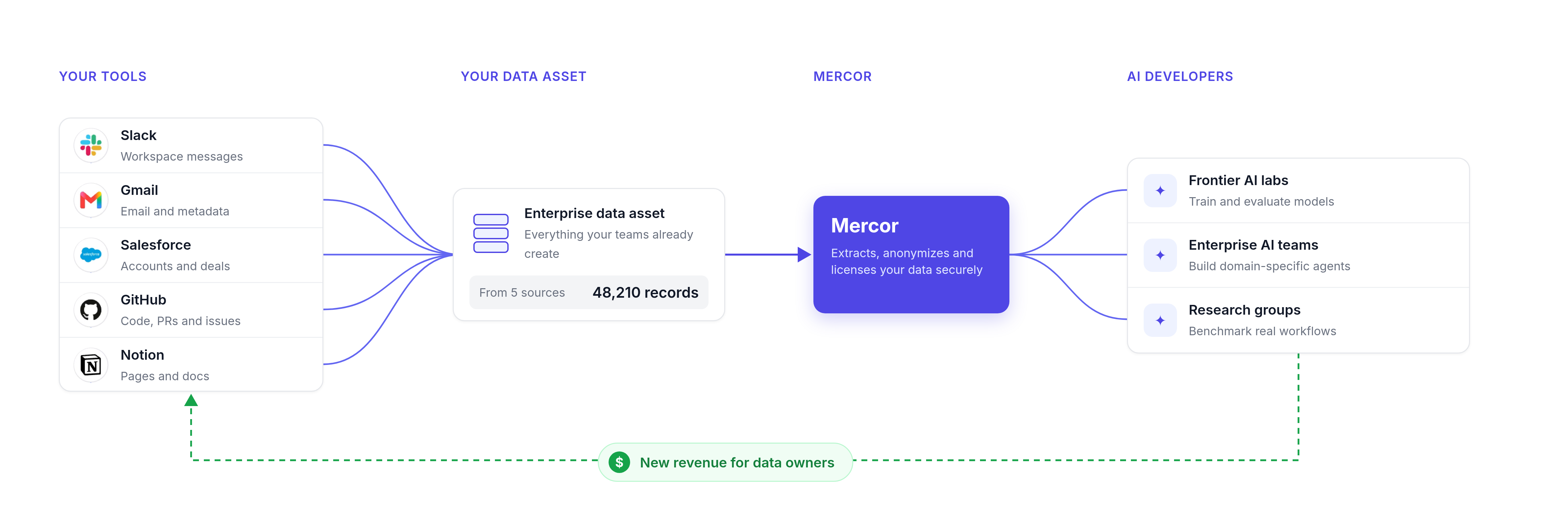
AI developers already bring their data needs to Mercor, and Mercor runs the data extraction and anonymization in-house. A company gains access to this market through a single partnership.
What makes a dataset valuable
The opportunity extends across industries and business functions. Engineering organizations accumulate years of code changes, technical discussions, and issue resolutions. Sales teams generate customer interactions and deal histories. Professional services firms produce research, analysis, and project documentation. Each represents a potentially valuable record of specialized work.
The commercial value of this information depends on several factors, including its uniqueness, historical depth, volume, and the relationships between records across systems. A history that links, for example, a Slack thread to a ticket to the code change shows why a certain decision was made.
Through Mercor Data Partnerships, organizations can license qualifying datasets to AI developers while retaining ownership of their underlying business information. Mercor runs the process required to extract, process, and prepare the data for commercialization.
How a data partnership works
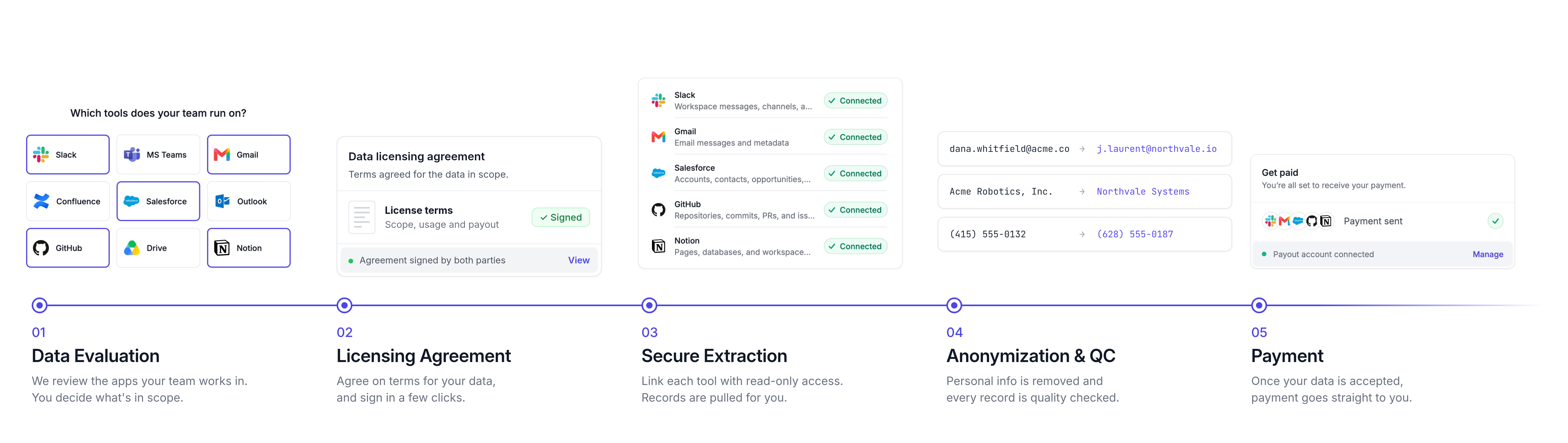
Mercor manages the process from initial evaluation to payment.
1. Tell Mercor about your data: Companies begin by sharing which systems they use, how much historical information they hold, and the approximate volumes available. Mercor evaluates the data against current demand from AI developers to identify potential licensing opportunities.
2. Receive an offer and agree on terms: Mercor provides an indicative commercial offer based on the characteristics of the available data. We work together to establish the licensing scope, permitted uses, security requirements, and commercial terms before proceeding.
3. Connect your systems: Mercor connects to the agreed systems and extracts the relevant records. The data is then processed through anonymization and quality-control workflows to remove identifying information while preserving useful relationships between records.
4. Complete delivery and receive payment: Once the agreed dataset meets the applicable requirements, Mercor coordinates delivery and compensation according to the partnership agreement.
The process is designed to minimize the technical work required from your business. Rather than building custom extraction pipelines, preparing datasets, or managing relationships with individual AI developers, partners work through Mercor’s existing infrastructure.
What you provide: the tools in scope, sign-off on the license, read-only access, and your payout details.
What Mercor manages: evaluating and pricing your data, drafting the agreement, secure extraction, anonymization and quality checks, and getting you paid.
Protecting your company’s data
Trust and privacy are fundamental to the decision and at the forefront of how we built our system. Enterprise records can contain employee information, customer details, confidential communications, and commercially sensitive material. A responsible partnership must address how that information is accessed, processed, protected, and used.
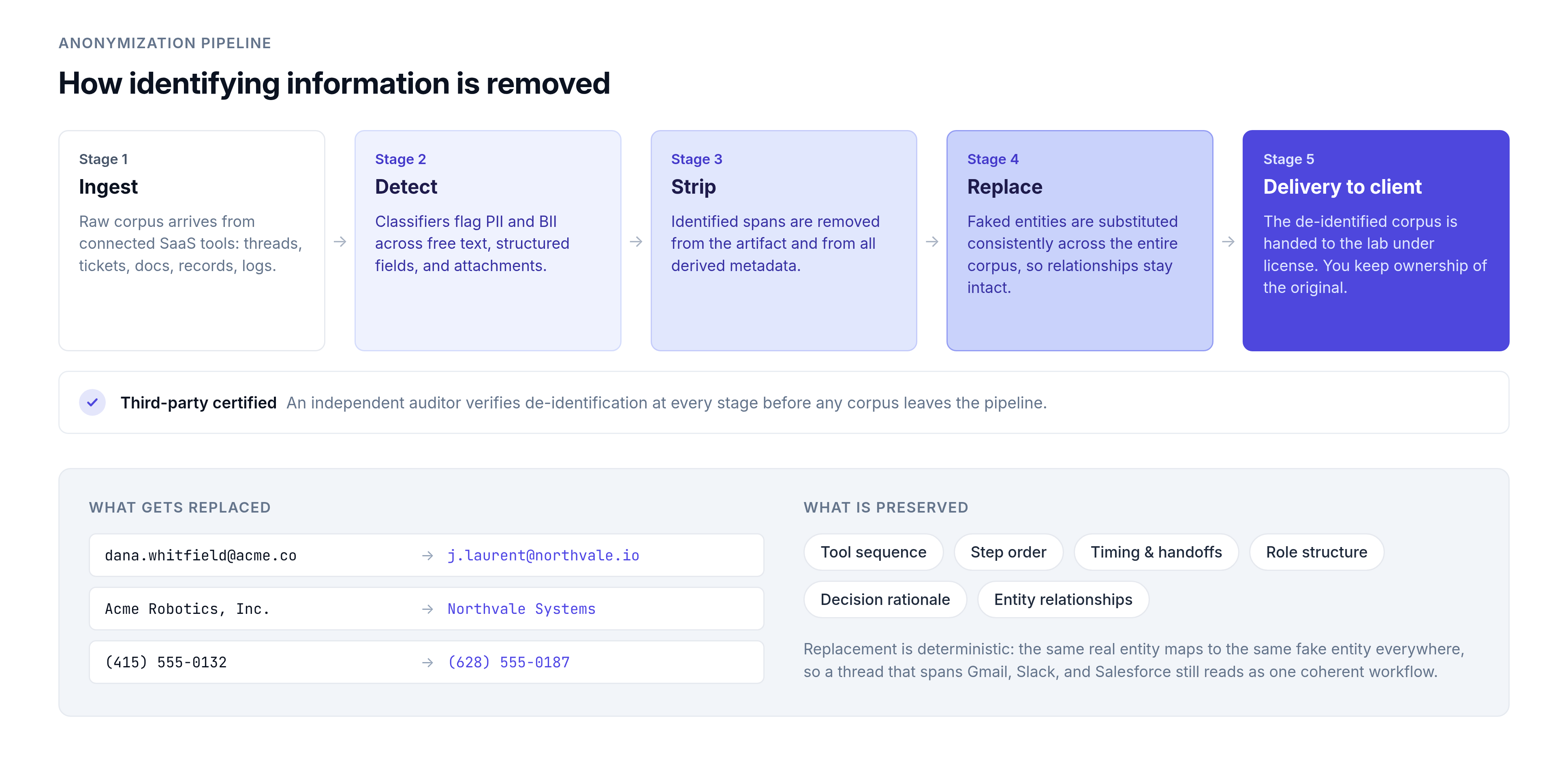
Mercor’s anonymization infrastructure is designed to remove personally identifying information while preserving the relationships that make enterprise records useful. For example, when the same customer appears across an email, support ticket, and CRM record, consistent replacement can preserve the connection between those interactions without retaining the customer’s original identity.
Identifying information can appear in free-form text, document contents, metadata, and contextual details that indirectly identify individuals or organizations. Mercor runs detection, transformation, and validation procedures appropriate to the data being processed. Anonymization reduces disclosure risk but does not automatically eliminate every re-identification risk.
Data licensing also requires clear contractual boundaries. Before participating, companies should understand which systems and categories of information are included, where their data is processed, who can access it, what uses are permitted, and how long information is retained. Mercor works with partners to establish the applicable terms and processing requirements before extraction begins.
Beyond historical data
Historical enterprise records are the starting point, but the opportunity may extend further as companies adopt AI agents in their own operations.
Agents generate records of how they complete tasks, interact with software, and respond to real-world conditions. With the right permissions and safeguards, these interactions can become another category of licensable data. Organizations may eventually be able to generate recurring revenue from new operational data rather than relying solely on a one-time historical dataset.
Mercor is developing the infrastructure to support this emerging market, connecting companies that generate valuable data with AI developers who need access to real-world information.
For businesses, the opportunity starts with understanding the value of what they already have.
Find out what your data is worth
Your company may already be generating information that AI developers want. Explore Mercor Data Partnerships to understand its potential value and how a secure licensing partnership works.
Explore Mercor Data Partnerships: https://www.data.mercor.com